

If you want to cut a taper on a table saw, one of the easiest and most repeatable ways to do it is with a table saw taper jig. I built this one mainly for tapering furniture legs, but it is also useful whenever you need to make a controlled angled rip cut.
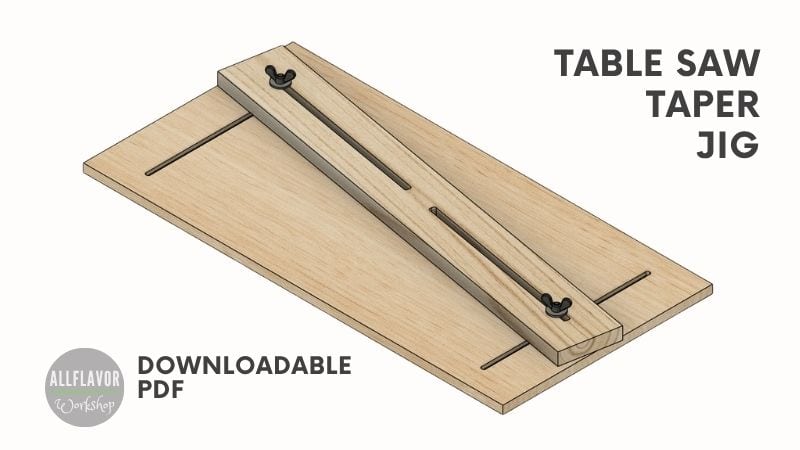
The jig is simple to build from plywood or MDF scraps and uses an adjustable fence, hold-down clamps, and a stop block to keep the workpiece secure during the cut. Once the fence is set, you can repeat the same taper on multiple pieces without having to measure and position each one from scratch.
I mainly use this jig for tapering table legs and other furniture parts, but it can also help straighten an uneven or live edge by guiding the board safely along the table saw fence. If straightening rough stock is your main goal, I also have a dedicated DIY Jointer Sled designed specifically for that job.
There are many ways to make a tapering jig, but I like this version because it is adjustable, easy to set up, and works for different workpiece sizes and taper angles.
In this guide, I’ll show you how I built the jig step by step, how the adjustable fence and stop block work, and how to use it to cut accurate tapers on a table saw.
Table Saw Taper Jig Video
If you want to see the complete build before getting started, watch the video below. I show how I make the base, route the T-slots, build the adjustable fence and stop block, and assemble the jig.
The video also shows how the jig works on the table saw and how I use it to taper furniture legs and straighten uneven edges.
If you enjoy the video, I’d really appreciate it if you subscribed to my YouTube channel. It helps me keep creating more woodworking jigs, workshop projects, and step-by-step build guides.
Table of Contents
- Table Saw Taper Jig Video
- Download Taper Jig Plans
- The Material you will need
- General Questions
- What is a Table Saw Taper Jig?
- Why Use a Tapering Jig
- Quick Build Overview
- How to Build a DIY Taper Jig for Table Saw (Step-by-Step)
- Step 1: Cut the Base
- Step 2: Cut the T-Slots
- Step 3: Build the Adjustable Fence
- Step 4: Make the Stop Block and Assemble the Jig
- How to Cut a Taper on a Table Saw
- How to Straighten a Live Edge
- My Take
- Woodworking Jigs I used to build it
- FAQ
*Safety is your responsibility. Make sure you know what you’re doing and take all necessary safety precautions while working with power tools. Safety comes first!
Table Saw Taper Jig Plans
You can download the Table Saw Taper Jig Plans below if you want the main dimensions and layout organized in one place while building the jig.
The plans are useful alongside the step-by-step guide below, especially when cutting the base, positioning the T-slots, and building the adjustable fence and stop block.
Materials and Tools
Before starting the build, prepare the base material, fence, stop block parts, and the hardware needed for the adjustable setup.
Taper jig
- Base board – 300 × 600 × 12 mm
- Spruce fence – 80 × 600 × 18 mm
- Plywood scraps for the stop block
- Plywood Scrap Pieces for the Stopper – https://amzn.to/3TPULp2
Other:
- Hold Down Clamps – https://amzn.to/3RJPEEf
- Wood Glue – https://amzn.to/48ltKhJ
- Sandpaper Sheets – https://amzn.to/41OMx2p
- Drill Bits – https://amzn.to/48Kaaf7
- Router Bits (Straight Router Bit) – https://amzn.to/3NQNDVX
- M6 Bolts, Washers, T-Nuts, Wood Screws
- Hardware Assortment Kit – https://amzn.to/41PodgQ
DIY T-track Bolts
Tools:
- Table Saw – https://amzn.to/47mWiGf
- Grr-Ripper Push Block – https://amzn.to/3vjQSP7
- Trim Router – https://amzn.to/3HbQcOg
- Cordless Hand Drill – https://amzn.to/3HqLEnH
- Corded Hand Drill / Drill Press – https://amzn.to/3NSA3Bo
- Guide Rail Clamps – https://amzn.to/3tEKaCW
- F-Clamps – https://amzn.to/48ArzY1
- One Hand Clamps – https://amzn.to/48jGxkZ
- Machinist Square / Speed Square
- Measure Tape – https://amzn.to/3TN0SKM
Check all the Tools I Use
NOTE: The exact hardware can be adapted to what you already have in the workshop. The important part is that the fence and clamps can slide freely in the T-slots and lock securely in position.
We may earn an affiliate commission when you buy something through our retail links. As an Amazon Associate, AllFlavor Workshop earns from qualifying purchases.
What Is a Table Saw Taper Jig?
A table saw taper jig is a guide that holds a workpiece at a controlled angle while it moves past the saw blade. Instead of following the table saw fence directly, the workpiece is secured to the jig, which lets you make a straight tapered cut from one end of the board to the other.
I mainly use it for tapering furniture legs, but it can also be useful for angled rip cuts and for straightening an uneven edge on a board.
Because the fence on this jig is adjustable, you can change the taper angle and reuse the same setup for different projects and workpiece sizes.
Why Use a Tapering Jig?
A tapering jig makes these cuts much easier to control and repeat, especially when you need several matching parts.
Some of the main benefits are:
- Repeatable taper cuts – once the fence and stop block are set, you can cut multiple matching pieces.
- Adjustable setup – change the fence position to suit different taper angles and workpiece sizes.
- Better workpiece support – the clamps and stop block help keep the material stable throughout the cut.
- Useful for furniture making – especially table legs, stools, benches, and similar projects.
- More than just tapers – the jig can also help straighten an uneven edge when needed.
NOTE: If straightening rough or uneven boards is the main job, I prefer using my dedicated DIY Jointer Sled. This taper jig can do a similar job, but its main purpose is making adjustable taper cuts.
Quick Build Overview
| Item | Details |
|---|---|
| Project | Adjustable table saw taper jig |
| Main use | Cutting repeatable tapers on furniture legs and other workpieces |
| Base size | 300 × 600 × 12 mm |
| Fence | Adjustable spruce fence |
| Adjustment | DIY T-slots with sliding bolts and wooden knobs |
| Workpiece holding | Hold-down clamps and rear stop block |
| Other uses | Straightening uneven or live edges |
| Difficulty | Beginner to Intermediate |
Let’s Start Building!
This taper jig is made from three main parts: the base, adjustable fence, and stop block. The T-slots in the base and fence allow the parts to slide and lock in different positions, which makes the jig adjustable for different taper angles and workpiece sizes.
The fence supports the workpiece during the cut, while the hold-down clamps and rear stop block keep it from shifting as the jig moves along the table saw fence.
NOTE: The exact dimensions can be adjusted to suit your table saw and the size of the workpieces you normally use. The important part is keeping the base flat, the fence rigid, and the adjustment hardware secure.
How to Build a Table Saw Taper Jig
Step 1: Cut the Base
Start by cutting the base to 300 × 600 × 12 mm. Try to keep the edges straight and square, because the base will ride directly against the table saw fence when the jig is in use.
Once the base is cut, mark the positions of the two T-slots. These slots will hold the adjustable fence, so take a little time to lay them out evenly and make sure they run straight along the base.
I used a trim router to cut the slots.
💡TIP: Start with a flat piece of plywood or MDF. A warped base can make the jig harder to adjust and less stable on the saw.
NOTE: The exact base size is not critical. You can make it longer or wider to suit your table saw and the size of the workpieces you plan to taper.


Step 2: Cut the T-Slots
The two T-slots in the base allow the fence to slide and lock at different angles. I made these directly in the base using a trim router and straight router bit.
Start by routing a wider, shallow groove for the bolt head. The groove should be deep enough for the bolt head to sit below the surface so it does not interfere with the workpiece or the table saw.
Next, route a narrower slot through the center of the groove. This allows the threaded part of the bolt to pass through while the wider bolt head remains captured underneath.
Repeat the same process for the second T-slot.
Before moving on, insert the bolts and make sure they slide smoothly along the entire length of the slots without binding.
💡TIP: Test the slot with the actual bolt you plan to use before finishing the second track. It is much easier to adjust the width or depth at this stage.
NOTE: The bolt heads must sit completely below the top surface of the base. Anything sticking above the surface can prevent the workpiece or fence from sitting flat.


Find This Blog Post Useful?
Join my newsletter to receive the latest news, tutorials, and project plans sent directly to your inbox!
Step 3: Build the Adjustable Fence
Cut the fence to 80 × 600 mm from a straight piece of wood. I used spruce, but any straight and reasonably rigid hardwood or softwood can work.
Mark two T-slots along the centerline of the fence. These slots serve two purposes: they allow the fence to attach to the base and also give you mounting points for the hold-down clamps and rear stop block.
Because the fence is relatively narrow, I routed the slots carefully with a multi-purpose router jig. Once the slots are finished, lightly sand the edges to remove any splinters and make sure the bolts slide freely.
Instead of routing one long continuous slot, I prefer to make two separate slots with a solid section left in the middle. This keeps the fence stronger and helps reduce the chance of bending or warping.
💡TIP: Test the bolts and clamp hardware in the slots before assembly. They should slide smoothly but lock firmly when tightened.
NOTE: Keep the fence straight and rigid. Any twist or bow in the fence can affect how securely the workpiece sits during the cut.


Step 4: Make the Stop Block and Assemble the Jig
Cut two plywood pieces for the stop block and join them together with glue and screws. The longer piece forms the main body, while the shorter piece creates the rear support that the workpiece can register against.
Drill a mounting hole through the longer piece so the stop block can attach to the slot in the fence and slide into position as needed.
Once the stop block is finished, assemble the jig. Attach the hold-down clamps and stop block to the fence, then connect the fence to the base using the sliding bolts and wooden knobs.
The fence should move freely across the base and lock firmly when tightened. The hold-down clamps secure the workpiece during the cut, while the stop block helps position it consistently and prevents it from shifting backward.
💡TIP: Before using the jig on the saw, move the fence through its full adjustment range and make sure all bolts, clamps, and knobs tighten securely.
NOTE: Position the stop block so it supports the workpiece without interfering with the blade path.


How to Cut a Taper on a Table Saw
Once the jig is assembled, setting it up for a taper cut is straightforward. The main thing is to position the workpiece so the cut line follows the edge of the jig while the base rides against the table saw fence.
-
Place the taper jig on the table saw between the blade and the rip fence.
-
Adjust the rip fence so the edge of the jig runs close to the blade and the jig can move smoothly forward.
-
Mark the taper line on the workpiece.
-
Position the workpiece on the jig so the taper line aligns with the cutting edge of the jig.
-
Adjust the fence and stop block until the workpiece sits in the correct position.
-
Secure the workpiece firmly with the hold-down clamps.
-
Start the saw and guide the jig forward along the rip fence, keeping your hands well away from the blade.
The jig keeps the workpiece fixed at the chosen angle while the base follows the fence, giving you a straight and repeatable taper cut.
💡TIP: Make a test cut on scrap first, especially when setting up a taper angle for the first time. It is much easier to fine-tune the fence position before cutting the final workpiece.
NOTE: Always check the complete blade path before starting the saw. The clamps, bolts, fence, and stop block must stay clear of the blade throughout the cut.
Cutting Matching Tapers on Multiple Pieces
Once the fence and stop block are set, leave them in position and use the same setup for the remaining workpieces. This makes it much easier to produce matching furniture legs or repeated tapered parts.
If you need to taper more than one face of a leg, rotate the workpiece, register it against the same stop block, clamp it again, and make the next cut.


Using the Taper Jig to Straighten an Uneven or Live Edge
This taper jig can also be used to straighten an uneven or live edge before making a regular rip cut on the table saw.
The setup is similar to making a taper. Position the board on the jig so the uneven edge extends past the cutting line, then secure it firmly with the hold-down clamps and stop block. As the jig rides along the table saw fence, the blade creates a straight reference edge on the workpiece.
Once one edge is straight, you can remove the board from the jig, place the new straight edge against the rip fence, and cut the opposite side normally.
💡TIP: Remove only as much material as necessary to create a clean straight reference edge. This helps preserve the usable width of the board.
NOTE: This works well when you occasionally need to straighten an uneven edge. If stock straightening is the main job, I prefer using my dedicated DIY Jointer Sled, which is designed specifically for that purpose.

My Take
I’ve used this table saw taper jig mainly for furniture legs and other angled rip cuts, and I still think it is one of those simple jigs that is worth having around the workshop.
What I like most is the adjustable fence and stop block. Once everything is set, I can repeat the same taper on several pieces without measuring and positioning each one again. The hold-down clamps also make it much easier to keep the workpiece securely in place during the cut.
The jig can also be used to straighten an uneven edge, which makes it a little more versatile. For regular stock straightening, though, I prefer my dedicated DIY Jointer Sled, while this jig stays primarily set up for taper cuts.
It is a relatively simple build, does not require much material, and the dimensions can easily be adjusted to fit your own table saw and the type of projects you build.
If you want to make one for your workshop, you can also download the Table Saw Taper Jig Plans with the main dimensions and build references and use them together with the step-by-step guide above.

Woodworking Jigs Used for This Project
These are some of the jigs and workshop setups I used while building the taper jig. Not all of them are necessary, but they make the build easier and help with accurate cutting, routing, drilling, and layout.
-
Marking Gauge – useful for accurate layout and repeatable measurements
-
DIY Dado Jig for a Trim Router – helpful for routing straight grooves
-
Multi-Purpose Groove Jig – another option for controlled router cuts
-
Small Table Saw Crosscut Sled – useful for cutting smaller parts accurately
-
DIY Stand for a Hand Drill – helps with more controlled drilling
-
DIY Drill Press Table – useful for repeatable hole placement
-
Star Knob Jig – makes it easier to produce the wooden adjustment knobs used on the jig
You do not need all of these to build the taper jig, but they are good examples of how a few simple workshop jigs can make the process more accurate and repeatable.
Frequently Asked Questions
What is the best way to cut a taper on a table saw?
The easiest and most repeatable way is to use a table saw taper jig. The jig holds the workpiece at the required angle while the base rides against the table saw fence, which makes it easier to produce a straight and consistent taper.
How long should a table saw taper jig be?
The jig should be long enough to support the workpiece safely through the entire cut. My jig is 600 mm long, which works well for furniture legs and similar projects, but you can make it longer if you regularly work with larger pieces.
Can a taper jig be used to straighten a board?
Yes. A taper jig can also work as a simple straight-line ripping jig by holding an uneven or live-edge board in a fixed position while the jig runs against the table saw fence.
For regular stock straightening, though, I prefer using my dedicated DIY Jointer Sled.
How many sides of a table leg should be tapered?
It depends on the design. Many furniture legs are tapered on two inside faces, while others are tapered on all four sides for a lighter and more symmetrical look.
If you are tapering multiple sides, use the same stop block and fence setup so the cuts remain consistent from one face to the next.
