
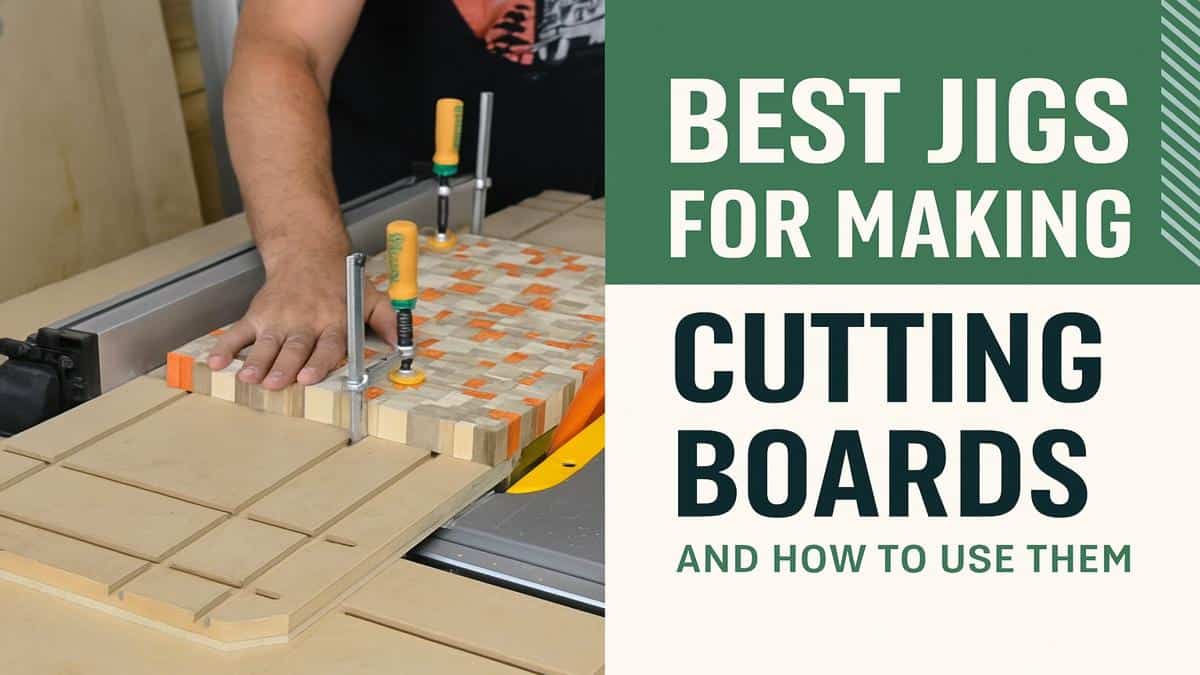
Cutting boards are one of my favorite woodworking projects. They can be simple or highly detailed, made from a few strips of wood or built as complex end-grain designs. No matter what type of cutting board I’m making, I find myself reaching for the same set of jigs over and over again.
These jigs help with every stage of the build process—from preparing rough stock and straightening edges to flattening the board, routing juice grooves, adding handles, and applying the final touches. Some are essential, while others simply make the process faster, easier, and more repeatable.
Over the years, I’ve built and refined a collection of cutting board jigs that now live in my workshop full-time. Together, they form a complete workflow that helps me build cleaner, more accurate cutting boards with less frustration and better results.
In this guide, I’ll walk you through the cutting board jigs I use most, explain what each one does, and show you where it fits into the overall cutting board-making process.
If you want the more complete version of these builds, I also now offer premium woodworking plans for selected cutting board jigs and bundles. I’ll point you to the best place to start further down in the article.
Table of Contents
- The Cutting Board Jig Workflow
- What Makes These Jigs Perfect for Cutting Boards?
- Jointer Sled
- Crosscut Sled for Table Saw
- Router Flattening Jig
- Multi-Purpose Router Jig
- Juice Groove Jig
- Benchtop Router Table
- Handle Jig
- Sanding Block
- Ruler Marking Jig
- Cutting Board Jigs at a Glance
- PLANS for the Complete Cutting Board Jig Collection
- Final Thoughts
- Frequently Asked Questions (FAQ)
📌 Save THIS PIN to your Board on Pinterest!
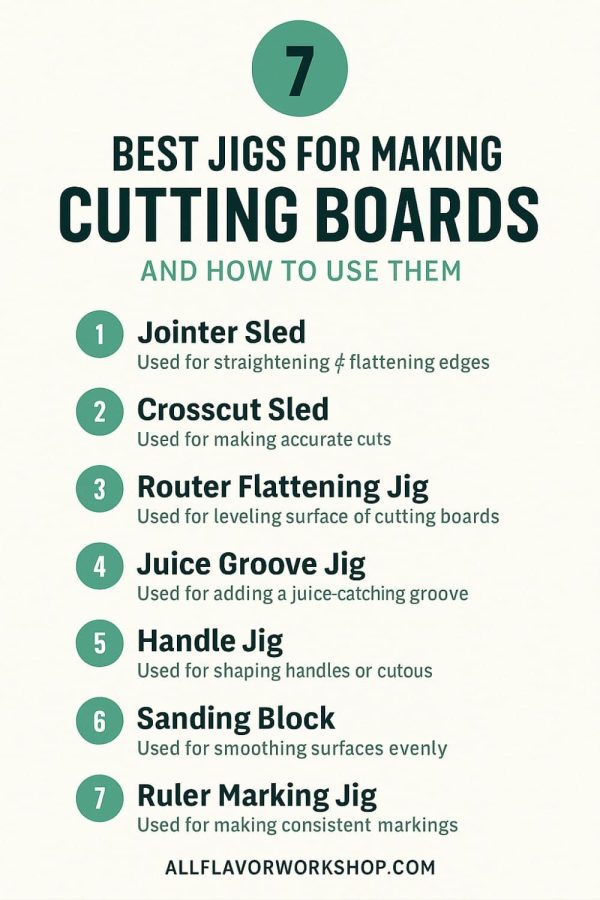
The Cutting Board Jig Workflow
Before diving into the individual jigs, it helps to understand where each one fits into the overall cutting board-making process. While not every project requires every jig, these are the ones I use most often when building cutting boards in my workshop.
| Cutting Board Stage | Recommended Jig |
|---|---|
| Prepare rough stock | Jointer Sled |
| Cut strips and size boards | Crosscut Sled |
| Flatten the surface | Router Flattening Jig |
| General routing operations | Multi-Purpose Router Jig |
| Add juice grooves | Juice Groove Jig |
| Add edge profiles (roundovers, chamfers) | Benchtop Router Table |
| Add handles | Handle Jig |
| Final sanding | Sanding Block |
| Layout and marking | Ruler Marking Gauge |
These are the cutting board jigs I use most often in my workshop. Together they cover the entire process—from preparing rough stock and flattening surfaces to routing details and applying the final touches.
What Makes These Jigs Perfect for Cutting Boards?
Making a great cutting board is all about precision, consistency, and repeatability. While you can certainly build a cutting board without any jigs, the process becomes much easier—and the results much better—when you have the right tools guiding the work.
The jigs in this guide cover the entire cutting board-making process. Some help prepare rough stock, others flatten glued-up boards, and some are designed for adding details like juice grooves, handles, and layout markings.
Here are a few common problems these jigs solve:
- Crooked or uneven edges → Jointer Sled
- Inaccurate sizing and trimming → Crosscut Sled
- Warped glue-ups → Router Flattening Jig
- Inconsistent routing operations → Multi-Purpose Router Jig
- Uneven juice grooves or handles → Juice Groove Jig
- Inconsistent edge profiles and chamfers → Benchtop Router Table
- Uneven handle placement → Handle Jig
- Repeated measurements and layout work → Ruler Marking Gauge
Some of these jigs are essential—especially the first four. Others, like the Benchtop Router Table, Juice Groove Jig, and Handle Jig, help add the details that make a cutting board look and feel more professional.
Most importantly, these jigs work together. Rather than solving a single problem, they form a complete workflow that takes you from rough lumber to a finished cutting board.
1. Jointer Sled
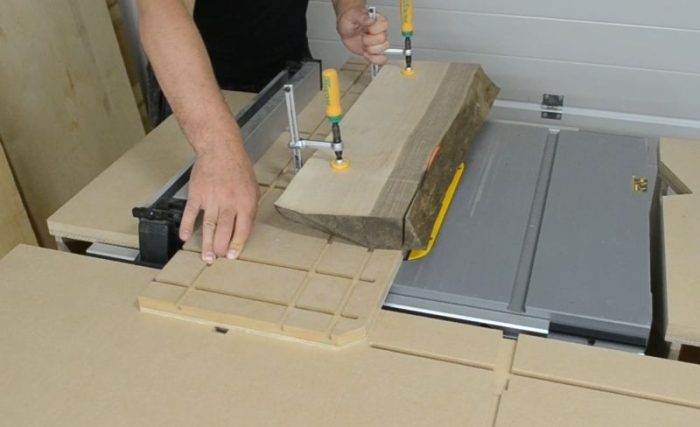
A jointer sled is one of the first jigs I reach for when building a cutting board—especially when starting with rough or uneven stock. This sled helps you straighten edges, square up boards, and remove twists or bows before you move on to cutting and gluing.
The nice thing is that this same jig can double as a tapering jig when needed. That makes it incredibly versatile—not just for cutting boards but for furniture parts, table legs, or any long angled cuts.
Why It’s Useful
- Straightens warped or uneven board edges
- Creates clean glue joints for cutting boards
- Can double as a tapering jig
- A great alternative if you don’t own a jointer
My Setup
My jointer sled runs along the table saw fence and holds the board securely using toggle clamps. It allows me to straighten one edge of a board before cutting the opposite edge parallel using the table saw fence.
I use this jig on nearly every cutting board I build. Whether I’m working with rough lumber or boards that have developed a slight bow, the jointer sled helps create straight, square edges that are ready for glue-up.
An added bonus is that this jig can also serve as a tapering jig, making it useful for many other woodworking projects beyond cutting boards.
Best For:
- Edge grain cutting boards
- End grain cutting boards
- Rough lumber preparation
- Small workshops without a jointer
Related:
2. Crosscut Sled for Table Saw
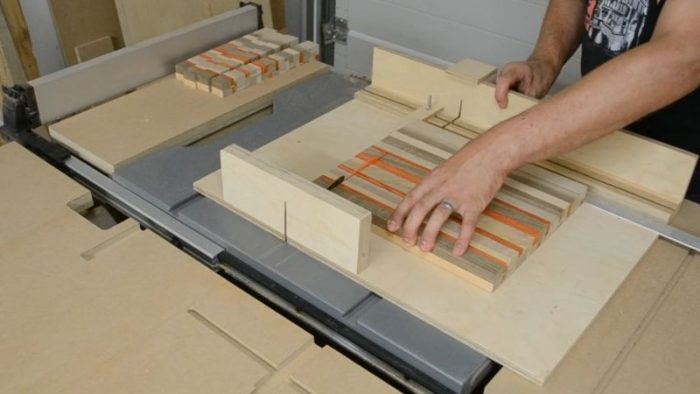
This is one of the most-used jigs in my workshop—especially when building cutting boards. Once the boards are jointed, the crosscut sled is what I use to cut the strips to size, and after the glue-up, to trim the ends square, size the final piece, or clean up edges after flattening.
A simple sled with a solid fence and runners makes it easy to get repeatable 90° cuts with much more control and accuracy than the miter gauge alone.
Why it’s useful
- Cuts cutting board strips to precise lengths
- Squares up glue-ups and finished boards
- Produces accurate, repeatable 90° cuts
- Safer and more stable than a miter gauge
- Ideal for both edge grain and end grain boards
My setup
My crosscut sled rides in the table saw miter slots and features a rigid rear fence that is calibrated to 90°. I also use stop blocks whenever I need to cut multiple pieces to the same length.
This jig is involved in almost every cutting board build I make. I use it to cut strips before glue-up, trim boards to final size, square up ends, and clean up edges after flattening.
It may look like a simple jig, but having a well-tuned crosscut sled makes a huge difference. Accurate cuts lead to tighter glue joints, cleaner corners, and better-looking finished boards.
Best For:
- Cutting board strips
- Trimming glue-ups
- Squaring cutting boards
- Batch production and repeat cuts
3. Router Flattening Jig
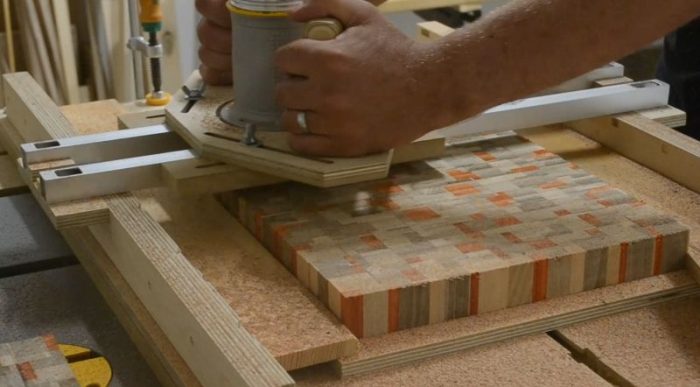
When you’re building cutting boards—especially end grain boards or thicker glue-ups—flattening the surface can be tricky without a planer or drum sander (even with a planer I prefer to use the flattening jig when surfacing end grain boards). That’s where a router flattening jig comes in.
This jig lets you level out warped, uneven, or slightly twisted boards with precision. It’s especially useful after glue-ups when the surface isn’t perfectly flat, or if your boards moved during clamping.
Why it’s useful
- Flattens rough boards before glue-up
- Levels cutting boards after glue-up
- Works well for edge grain and end grain boards
- A great alternative to a planer or drum sander
- Can be scaled for different board sizes
My setup
My flattening jig uses side rails and a sliding router carriage that travels back and forth across the workpiece. I use a wide surfacing bit and make overlapping passes until the entire surface is flat.
One thing I like about this setup is that the router carriage is actually my Multi-Purpose Router Jig. The same router base that I use for dados, mortises, circles, and T-tracks can also be mounted on the flattening jig. This makes both jigs much more versatile and saves space in the workshop.
I use this setup regularly for cutting boards, especially end grain boards and larger glue-ups. Before building the flattening jig, I spent a lot more time sanding away ridges and trying to correct uneven surfaces. Now I simply flatten the board and move on to sanding.
Best For:
- End grain cutting boards
- Large glue-ups
- Warped boards
- Small workshops without a planer
For larger cutting boards, this is the jig that makes the biggest difference in the final result.
Related:
🔗 How to Build a DIY Router Flattening Jig
4. Multi-Purpose Router Jig
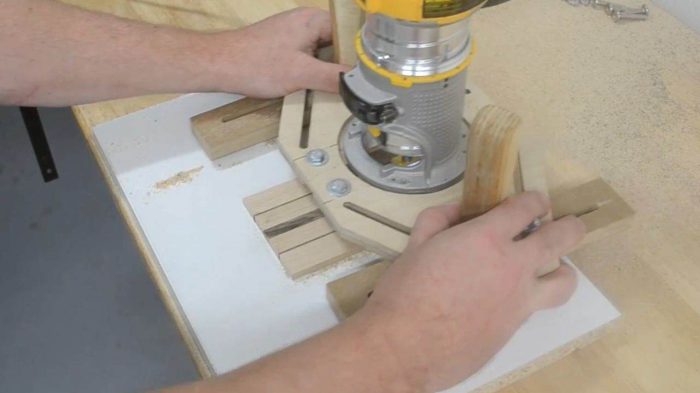
A multi-purpose router jig is one of the most versatile tools in my cutting board workflow. Instead of building a separate jig for every routing task, I can use the same router base with different guide rails and accessories depending on the operation.
I originally built this jig to make homemade T-tracks, but over time it became much more than that. Today I use it for cutting dados, mortises, circles, flattening smaller workpieces, and as the router carriage for my flattening jig.
Why It’s Useful
- Cuts dados, grooves, and rabbets
- Can be used for routing mortises
- Works as a circle-cutting jig with a simple attachment
- Creates homemade T-tracks and T-slots
- Serves as the upper carriage for a router flattening jig
- Replaces several dedicated router jigs
My Setup
My version consists of a large router base with integrated T-slots, adjustable guide rails, and removable accessories. The larger base gives the router more stability than the factory base, while the guide rails help keep cuts accurate and repeatable.
One thing I like most about this jig is that it grows with the workshop. I can use it on its own for freehand routing, add guide rails for dados and mortises, or mount it on the flattening jig when surfacing cutting boards.
Because it performs so many different tasks, it has become one of the most-used router jigs in my shop.
Best For:
- Cutting board flattening
- Dados and grooves
- Mortises
- Homemade T-tracks
- Circle cutting
- General router work
Related:
5. Juice Groove Jig
If you want your cutting boards to look polished and professional, adding a juice groove is a great finishing touch—especially on boards meant for carving or prepping juicy foods. But cutting a clean, even groove around the edge of a board is nearly impossible without a jig.
This simple router jig ensures repeatable, centered, and smooth juice grooves every time—no wandering lines, no overcuts (it still needs a bit of experience though ;).
Why it’s useful
- Creates clean and consistent juice grooves
- Keeps the groove evenly spaced from the edge
- Works with different cutting board sizes
- Produces more professional-looking results
- Reduces the chance of routing mistakes
My setup
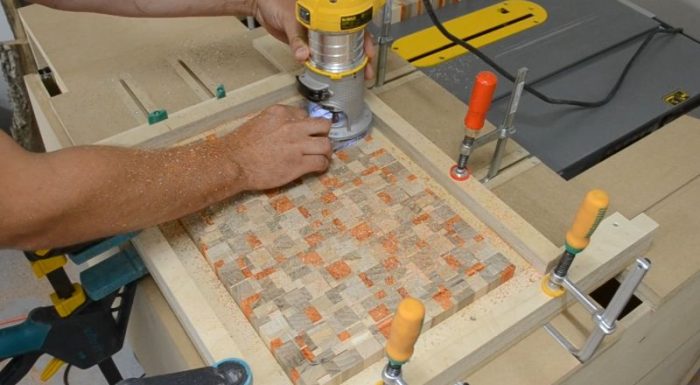
My juice groove jig uses adjustable fences that can be repositioned to fit different cutting board sizes. Once the board is secured, the fences guide the router around the perimeter and help maintain a consistent offset from the edge.
I typically use this jig near the end of the build process, after the board has been flattened, trimmed, and sanded. A juice groove is a small detail, but it can make a cutting board look much more refined and professional.
One thing I’ve learned over time is that setup matters. Taking a few extra minutes to position the jig accurately makes routing the groove much easier and greatly reduces the chance of mistakes.
Best For:
- Carving boards
- Large cutting boards
- Serving boards
- Repeatable juice grooves
- Consistent edge offsets
If you regularly make cutting boards, a juice groove jig is one of those tools that quickly pays for itself in both accuracy and repeatability.
Related:
🔗 DIY Juice Groove Jig for Router
6. Benchtop Router Table
A benchtop router table is one of those tools that becomes more useful the more cutting boards you make. While many routing operations can be done with a handheld router, I often prefer using the router table when working on board edges, profiles, and other repeatable cuts.
I use mine primarily for adding roundovers, chamfers, and decorative edge profiles that give a cutting board a more finished and professional appearance. It also provides better control when working with smaller workpieces or when making the same cut repeatedly.
Why It’s Useful
- Creates clean and consistent edge profiles
- Makes roundovers and chamfers easier to cut
- Improves control during routing operations
- Speeds up repeatable edge work
- Produces cleaner and more professional-looking results
My Setup
My benchtop router table is a compact shop-built version that fits comfortably in a small workshop. It includes a fence, adjustable stop blocks, and a removable insert plate, making it flexible enough for a wide range of routing tasks.
When building cutting boards, I typically use it after routing the juice groove and before the final sanding stage. This is where I add roundovers, chamfers, or other edge treatments that soften sharp corners and give the board its finished look.
One thing I particularly like is how repeatable the setup is. Once the fence and bit height are adjusted, I can process multiple boards quickly while keeping the profiles consistent from one board to the next.
👉 This jig is also included in the full Cutting Board Jig Bundle if you want the more complete version of the plans.
Best For:
- Roundovers
- Chamfers
- Decorative edge profiles
- Edge cleanup
- Small repeatable routing operations
A router table isn’t strictly required for making cutting boards, but once you start using one, it’s hard to imagine going back. It makes many routing tasks faster, safer, and much more consistent.
Related:
7. Handle Jig (Router Handle Template)
Adding handles is one of the last steps when making a cutting board, but it can make a huge difference in how the finished board feels and functions. Whether you prefer finger grips, routed slots, or decorative cutouts, a handle jig helps keep everything consistent and repeatable.
Without a jig, it can be difficult to position handles accurately or create the same shape from one board to the next. A simple template solves that problem and makes the routing process much easier.
Why It’s Useful
- Creates consistent handle shapes and positions
- Makes cutting boards easier to carry and use
- Works with different handle styles
- Improves the overall appearance of the board
- Speeds up repeat builds and batch production
My Setup
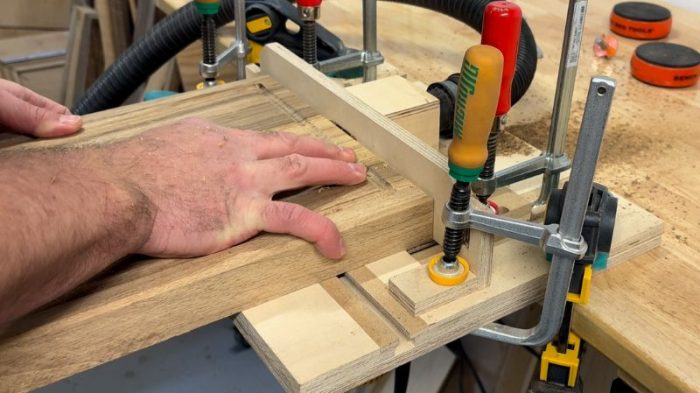
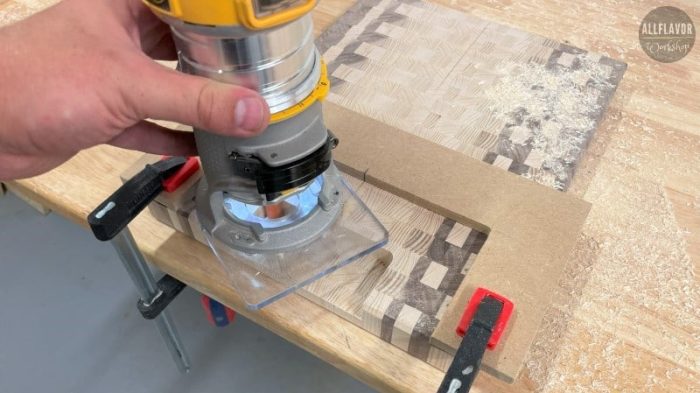
I use a simple router handle jig with a centered template opening that is clamped to the cutting board. Once aligned, I use a trim router and make several shallow passes until the handle is fully routed.
Most of the time I use this jig for finger grips on the underside of cutting boards, but the same concept can be adapted for routed handles, slots, and decorative cutouts.
It’s a relatively simple jig, but it helps create clean, professional-looking handles that would be difficult to reproduce consistently by hand.
Best For:
- Finger grips
- Routed handles
- Serving boards
- Cutting boards
- Batch production
Related:
🔗 DIY Router Handle Jig – How to Add Handles to a Cutting Board
8. Sanding Block
Sanding is one of the final stages of making a cutting board, and it’s often the step that separates a good board from a great one. A sanding block helps keep the surface flat, applies pressure evenly, and gives you more control than simply wrapping sandpaper around your hand.
While I typically use a random orbital sander for the majority of the sanding, I still reach for a sanding block regularly. It’s especially useful for edges, corners, small touch-ups, and situations where I want to maintain a crisp profile.
Why It’s Useful
- Helps maintain flat surfaces while sanding
- Applies even pressure across the workpiece
- Reduces the risk of rounding edges unintentionally
- Works well for edge cleanup and detail work
- Requires no power tools
My Setup
I built a few sanding blocks in different sizes, but the one I use most often is made from Baltic birch plywood and fits comfortably in my hand. The design allows me to change sandpaper quickly while keeping it securely clamped in place.
Even though it is a simple jig, it plays an important role in the finishing process. I often use it to break sharp edges, clean up router marks, and prepare cutting boards for oiling.
For anyone working in a small shop, a good sanding block is one of those tools that gets used far more often than expected.
Best For:
- Final surface preparation
- Edge cleanup
- Breaking sharp corners
- Removing router marks
- Preparing boards for finish
Related:
🔗 DIY Sanding Block – Easy to Make

9. Ruler Marking Gauge
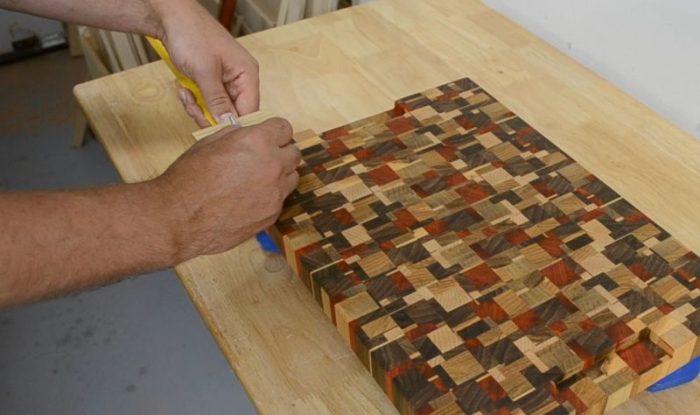
This is probably the smallest jig in this guide, but it’s also one of the ones I use most often. While it doesn’t cut, route, or flatten anything, it helps keep measurements consistent throughout the entire cutting board build.
Accurate layout work is important when marking handle locations, juice groove offsets, rubber feet positions, centerlines, or decorative details. A ruler marking gauge speeds up these tasks and helps eliminate small measuring errors that can add up over the course of a project.
Why It’s Useful
- Speeds up repetitive measurements
- Creates consistent layout lines and offsets
- Helps position handles, grooves, and rubber feet
- Reduces measuring mistakes
- Useful throughout the entire build process
My Setup
My ruler marking gauge is made from a wooden body with an embedded steel ruler and a simple locking mechanism. Once the desired measurement is set, I can quickly transfer the same offset to multiple locations without repeatedly measuring and marking.
I use it frequently when laying out juice grooves, positioning handles, marking centerlines, and locating rubber feet on the underside of cutting boards.
It may not be as exciting as a router jig or sled, but it’s one of those tools that quietly improves accuracy on almost every project.
Best For:
- Layout lines
- Centerlines
- Juice groove offsets
- Handle positioning
- Rubber feet placement
- Batch production
Related:
🔗 DIY Ruler Marking Gauge – Fast, Accurate Layout Lines
Cutting Board Jigs at a Glance
Before choosing which jig to build first, here’s a quick overview of the cutting board jigs covered in this guide and where they fit into the process.
| Jig | Primary Use | Best Stage | Priority |
|---|---|---|---|
| Jointer Sled | Straightening and squaring edges | Stock preparation | Essential |
| Crosscut Sled | Sizing and squaring boards | Throughout the build | Essential |
| Router Flattening Jig | Flattening boards and glue-ups | After glue-up | Essential |
| Multi-Purpose Router Jig | Routing operations and flattening carriage | Routing tasks | Highly Recommended |
| Juice Groove Jig | Routing juice grooves | Final detailing | Highly Recommended |
| Benchtop Router Table | Roundovers, chamfers, edge profiles | Final detailing | Highly Recommended |
| Handle Jig | Adding handles and finger grips | Final detailing | Recommended |
| Sanding Block | Surface preparation and finishing | Final finishing | Recommended |
| Ruler Marking Gauge | Layout and repeatable measurements | Throughout the build | Recommended |
If I had to start with just a few jigs, I would build the Jointer Sled, Crosscut Sled, Router Flattening Jig, and Multi-Purpose Router Jig first. Once those are in place, a Benchtop Router Table is the next upgrade I'd add for edge profiles, chamfers, and other finishing details.
Want to Build the Complete Cutting Board Jig Collection?
If you’re planning to build more than one of these jigs, I now offer a Cutting Board Jig Bundle that brings the core builds together in one place. It’s a good option if you want the more complete version of the plans, with metric + imperial dimensions, exploded views, clearer preparation, and more detailed materials and hardware information.
These jigs were developed and refined through dozens of cutting board builds, and together they form a complete workflow — from preparing rough stock and flattening boards to routing juice grooves, shaping handles, and adding the final details.
If that sounds like the setup you want in your shop, you can browse the full collection here:
👉 Browse the premium woodworking plans
Final Thoughts
Over the years, I’ve built many cutting boards—edge grain, end grain, serving boards, and everything in between. While every project is a little different, I keep coming back to the same set of jigs because they make the process faster, more accurate, and much more enjoyable.
If you’re just getting started, I would focus on four jigs first: the Jointer Sled, Crosscut Sled, Router Flattening Jig, and Multi-Purpose Router Jig. Together, they cover most of the cutting board-making process and provide the biggest improvement in accuracy and workflow.
The remaining jigs—the Juice Groove Jig, Benchtop Router Table, Handle Jig, Sanding Block, and Ruler Marking Gauge—help add the finishing touches that make a cutting board look and feel more professional.
One thing I’ve learned is that cutting board making isn’t really about building a single jig. It’s about creating a workflow where each jig solves a specific problem and helps the next step go more smoothly. When used together, these jigs can save hours of work and greatly improve the consistency of your results.
My woodworking journey actually started with building jigs. I enjoyed figuring out how they worked, improving them over time, and seeing how much easier they made each project. Many of the jigs in this guide are still the ones I use today whenever a new cutting board project lands on my workbench.
If you’re looking for the next jig to build, start with the one that solves your biggest challenge right now. Then keep adding to your jig collection as your cutting board projects grow. And if you want the more complete version of these builds, take a look at my premium woodworking plans on the plans page.
Frequently Asked Questions
Do I need special jigs to make a cutting board?
No, but jigs help a lot. While you can technically make a board without them, jigs improve accuracy, save time, and lead to cleaner results—especially if you plan to build more than one.
What jig should I build first for cutting boards?
Start with a jointer sled, a crosscut sled, and a router flattening jig. These three jigs alone will help you square up your stock and size your board properly. From there, add a flattening jig and juice groove jig as needed.
Can I flatten a cutting board without a planer?
Yes! A router flattening sled is a great alternative to a planer or drum sander. It lets you level your board using a trim or plunge router, even if it’s warped or uneven.
What is the most versatile jig for making cutting boards?
The Multi-Purpose Router Jig is probably the most versatile. It can be used for routing dados, grooves, mortises, homemade T-tracks, circle cuts, and even as the router carriage for a flattening jig.
Do I need separate jigs for juice grooves and handles?
Not necessarily, but dedicated jigs make these operations much easier and more repeatable. They help maintain consistent spacing, positioning, and routing depth across multiple cutting boards.
Can I use the same jigs for edge grain and end grain boards?
Yes. The jig setup stays mostly the same whether you’re making edge grain or end grain boards. You’ll just be more careful with flattening and sanding for end grain, which is tougher on tools.
