

I add juice grooves to a lot of the cutting boards I make, but I do not think every cutting board needs one.
A groove can be genuinely useful when you are carving meat, cutting juicy fruit, or working with anything that releases enough liquid to run toward the edge of the board.
But it also takes away some of the flat working surface, adds another step to the build, and — if you get it wrong — can ruin an otherwise finished cutting board.
I have done that too.
Routing the juice groove is usually one of the last steps in my builds, after the glue-up, flattening, trimming, and a lot of sanding. That means there is quite a bit of work already invested in the board before the router ever touches it.
So I do not add one just because cutting boards are “supposed” to have them.
I decide based on how I expect the board to be used.
In this article I will look at where a juice groove actually helps, where I would leave it out, and what I consider before cutting one.
And if you already know you want a groove and are looking for the actual routing process, continue with How to Cut a Perfect Juice Groove in a Cutting Board.
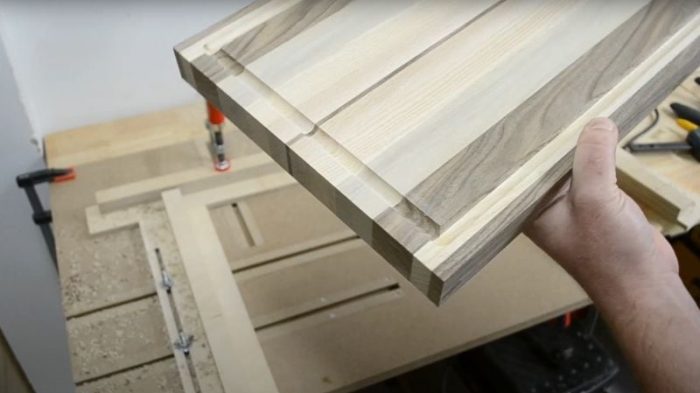
Table of Contents
- Quick Answer: Do You Need a Juice Groove?
- What Does a Juice Groove Actually Do?
- When a Juice Groove Is Worth Adding
- When I Would Skip the Juice Groove
- Cutting Board With vs. Without a Juice Groove
- Does Board Size and Thickness Matter?
- How Much Working Area Do You Lose?
- Should a Charcuterie Board Have a Juice Groove?
- One Side With a Groove, One Side Without
- If You Add One, Get the Setup Right
- How I Decide on My Own Boards
- Wrap-Up
- Frequently Asked Questions
Quick Answer: Do You Need a Juice Groove?
No — a juice groove is optional.
I add one when the board is likely to be used for:
- carving meat
- cutting juicy fruit
- preparing foods that release a lot of liquid
- general kitchen work where containing liquid is useful
I usually skip it when the board is mainly used for:
- vegetables
- bread
- cheese
- serving food
- charcuterie
- smaller everyday prep
- situations where maximum flat cutting space matters more
The groove is a useful feature, not a requirement. For me, the question is simply: Will this groove solve a problem on this particular board?
If yes, I add it. If not, I am perfectly happy leaving the surface completely flat.
What Does a Juice Groove Actually Do?
A juice groove is simply a shallow channel routed around the perimeter of the cutting surface.
Its job is to catch liquid before it reaches the edge of the board and runs onto the countertop.
That liquid could come from:
- a roast resting before carving
- steak or poultry
- tomatoes
- watermelon
- oranges
- pineapple
- other juicy fruit or vegetables
The idea is simple.
Instead of the liquid spreading across the full board and eventually running over the edge, part of it collects in the groove.
That is especially useful on a larger cutting board where the center is used for carving or food preparation.
But the groove does not magically increase the size of the board. It actually does the opposite. You trade some usable flat surface for liquid control. That is the main compromise.
When a Juice Groove Is Worth Adding
There are a few situations where I think a juice groove earns its place.
Carving Meat
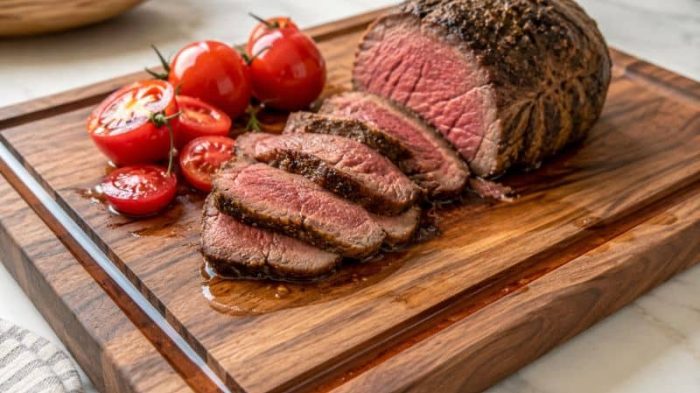
This is probably the clearest use case. A roast, steak, chicken, or other cooked meat can release a surprising amount of juice when it rests and is cut.
Without a groove, that liquid eventually reaches the edge. A properly sized groove gives it somewhere to collect.
Cutting Juicy Fruit
Watermelon is probably one of the best examples. Tomatoes, pineapple, oranges, and similar foods can also release enough liquid to make a groove useful.
Larger General-Purpose Cutting Boards
On a larger board, losing a little working area around the perimeter is usually not a big problem.
You still have plenty of flat space in the middle.
That is one reason I am much more likely to add a groove to a large edge-grain or end-grain board than to a small prep board.
Boards You Expect to Use for Many Different Jobs
If I am building one main kitchen board that is going to do a bit of everything, I often add the groove simply because it gives the board another useful function.
| Typical Use | Would I Add a Juice Groove? | Why |
|---|---|---|
| Carving meat | Yes | This is where the groove is most useful for catching liquid. |
| Watermelon and juicy fruit | Yes | Helps keep juice from running onto the worktop. |
| Large everyday cutting board | Usually | The lost perimeter space is less important on a larger board. |
| Vegetable prep | Optional | Most vegetables do not release enough liquid to make it essential. |
| Bread | Usually no | A flat surface is more useful than a liquid-catching groove. |
| Serving / charcuterie | Usually no | The groove takes away flat serving space without adding much value. |
When I Would Skip the Juice Groove
Sometimes a completely flat board is simply better.
1. Small Cutting Boards
On a small board, every centimeter of usable space matters.
Once you route a groove around the perimeter, the actual cutting area becomes noticeably smaller.
For something used for quickly chopping an onion, slicing a lemon, or making a sandwich, I would rather keep the surface flat.
2. Bread Boards
Bread does not need a liquid channel.
If anything, I would rather have a full flat surface — or build a dedicated bread board designed to deal with crumbs.
3. Mostly Vegetable Prep
If a board is used almost entirely for onions, herbs, carrots, garlic, peppers, and similar ingredients, I do not see a strong reason to add a groove.
4. Serving Boards
For serving, the perimeter is useful space.
Crackers, cheese, fruit, nuts, and cured meats often sit right up to the edge.
A groove simply interrupts that area.
5. Decorative Boards
If the grain pattern, inlay, live edge, or other detail is the main feature of the board, I may prefer not to cut a channel through it.
That was part of the thinking behind some of my more decorative face-grain boards.
A groove is functional, but it also changes the look of the finished piece.
Cutting Board With vs. Without a Juice Groove
Both versions have advantages.
| Feature | With Juice Groove | Without Juice Groove |
|---|---|---|
| Catching liquid | Better | Liquid can run off the edge |
| Usable flat area | Slightly reduced | Maximum usable space |
| Cleaning | Groove needs extra attention | Simpler surface |
| Build complexity | Requires accurate routing | No extra routing step |
| Risk during the build | Router slip can damage the finished board | No groove-related risk |
| Serving food | Less flat perimeter space | Usually better |
| Carving meat | Usually better | More chance of spills |
There is no universal winner. It really depends on what you want the board to do.
Does Board Size and Thickness Matter?
Yes. I think a juice groove makes much more sense on a reasonably large and substantial board than on a thin, small one.
There are two reasons.
1. You Need Enough Surface Area
- The groove is normally positioned in from the edge.
- That means the usable flat cutting area becomes smaller on all four sides.
- On a 40 cm / 16″ wide board, that is usually not a major sacrifice.
- On a much smaller board, you notice it immediately.
2. You Need Enough Thickness
- The groove removes material from the top surface.
- That is not a problem on a well-built, reasonably thick cutting board.
- But on a very thin board, I would question whether the groove is adding enough value to justify removing more material.
- The exact dimensions depend on the board, router bit, and design.
When I cut my own grooves, I normally keep them relatively shallow and proportional to the board rather than trying to make the deepest possible channel.
If you are interested in the actual offsets, groove depth, router bit, and routing method I use, they are covered in How to Cut a Perfect Juice Groove in a Cutting Board.
How Much Working Area Do You Lose?
Not a huge amount on a large board — but enough to think about. Suppose the groove runs around the whole board approximately 20–30 mm / 3/4–1-1/4″ in from the edge.
You are not completely losing that perimeter, because you can still place food over parts of it. But it is no longer one uninterrupted flat working surface. For most larger kitchen boards, that does not bother me.
On smaller boards, it does.
That is one reason I would make the decision before routing, not simply copy the feature from another board. Once you cut the groove, it is there.
Should a Charcuterie Board Have a Juice Groove?
Usually, I would say no.
A charcuterie board is mainly used for serving, so I normally want as much usable flat surface as possible. Cheese, crackers, fruit, cured meat, nuts, and bowls can all sit closer to the edge when there is no groove in the way.
It is also simply cleaner visually. That does not mean a serving board can never have one.
If you are building a dual-purpose board that will be used both for serving and for carving meat, the groove may still make sense. But for a dedicated serving board, I would normally leave it out.
I cover the broader difference between these two board styles in Charcuterie Board vs Cutting Board: What’s the Difference?.
One Side With a Groove, One Side Without
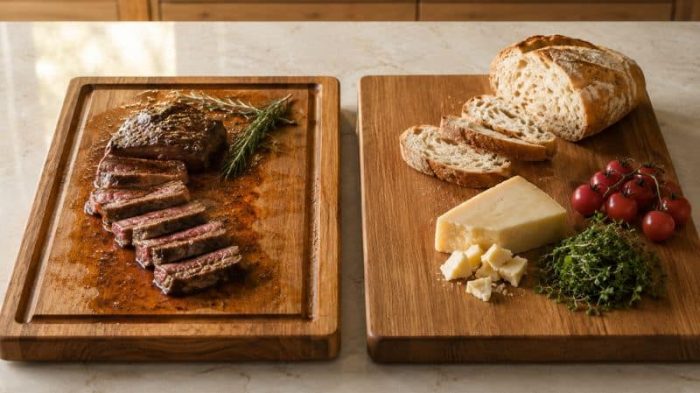
There is also a very simple compromise: use one side for the groove and leave the other side flat. I like this idea because it gives you two different working surfaces.
1. Groove Side
Use it for:
- meat
- juicy fruit
- anything where liquid control matters
2. Flat Side
Use it for:
- vegetables
- bread
- cheese
- serving
- general prep
This works best on a board without permanent rubber feet.
Once you add feet, one side naturally becomes the bottom.
I use feet on quite a few of my cutting boards because I like the stability and airflow they provide, so in those cases I simply decide whether the main working face needs a groove.
If you want to compare that design choice as well, see Cutting Board Feet vs No Feet.
If You Add One, Get the Setup Right
This is where the woodworking part becomes important. A juice groove looks like a very small detail, but it is one of those steps where a mistake is immediately visible.
And because I normally route the groove near the end of a cutting board build, a mistake here can waste a lot of work.
I have ruined grooves by:
- letting the router drift
- getting burn marks in the corners
- stopping too long in one spot
- routing too aggressively
- not keeping the router movement consistent
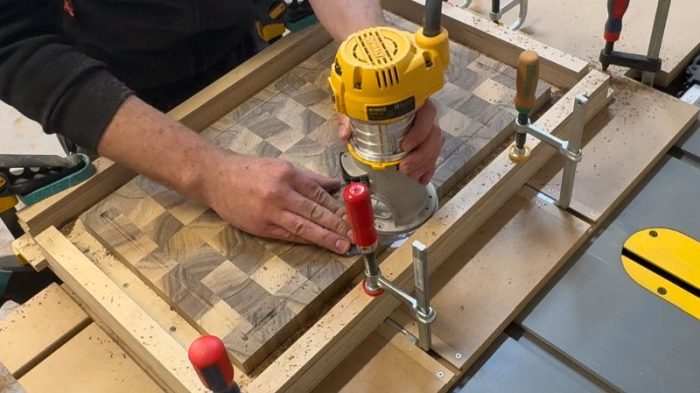
That is exactly why I built my DIY Juice Groove Jig.
The jig keeps the router path controlled around all four sides and lets me set the groove consistently on boards of different sizes.
I still take my time.
On end grain especially, I use shallow passes, control the router speed, and pay attention in the corners where burning is most likely.
💡TIP: Decide whether you actually need the groove before you reach this stage. Routing one just because it “looks like a proper cutting board” adds risk without necessarily adding usefulness.
How I Decide on My Own Boards
For me, the decision usually looks like this:
| Question I Ask | If Yes | If No |
|---|---|---|
| Will I regularly cut meat or juicy food? | I lean toward adding a groove. | A flat board may be more useful. |
| Is the board large enough? | The lost perimeter space is usually minor. | I normally keep the surface flat. |
| Is this mainly a serving board? | I usually skip the groove. | It depends on the cutting tasks. |
| Will both faces be used? | One grooved + one flat side can work well. | I optimize the main working face. |
| Does the groove improve how this board will actually be used? | Add it. | Leave it out. |
That last question is the one that matters most to me. I like building jigs and adding small details, but a feature should have a reason to be there.
A simple flat cutting board is not unfinished just because it does not have a groove. And a grooved board is not automatically better.
📌 Save THIS PIN to your Board on Pinterest!

Wrap-Up
A juice groove is useful, but it is not something every cutting board needs.
If I am building a large board that will regularly be used for carving meat, cutting watermelon, or preparing other juicy foods, I usually like having one.
It keeps liquid away from the edge and makes those jobs cleaner.
But for a small prep board, bread board, vegetable board, or serving board, I am often happier with a completely flat surface.
You get more working area, easier cleaning, and one less routing operation near the end of the build.
For me, that is the simplest way to decide:
Do not add a juice groove because cutting boards normally have one. Add it because the way you plan to use the board makes it useful.
If you decide that your board needs one, the next step is How to Cut a Perfect Juice Groove in a Cutting Board.
And if you plan to make more than one board, have a look at my DIY Juice Groove Jig. It is the setup I use to make the routing much more controlled and repeatable.
You can also find the juice groove jig together with the other tools I use throughout the board-making process in Best Jigs for Making Cutting Boards.
Frequently Asked Questions
Do all cutting boards need a juice groove?
No. A juice groove is optional. It is most useful for carving meat and cutting foods that release a lot of liquid. For bread, vegetables, serving, and smaller prep boards, a flat surface can be more practical.
Is a cutting board better with or without a juice groove?
Neither is automatically better. A groove helps contain liquid, while a flat board gives you more uninterrupted working space and is easier to clean. I choose based on how the board will be used.
Should a charcuterie board have a juice groove?
Usually not. A charcuterie board benefits from having as much flat serving area as possible. I would normally add a groove only if the board is also intended to be used regularly for carving or food preparation.
Can you add a juice groove to only one side of a cutting board?
Yes. Leaving one side flat and adding a groove to the other gives you two different working surfaces. This makes the most sense on boards without permanent rubber feet.
How deep should a cutting board juice groove be?
There is no single depth that works for every board. The groove should be deep enough to hold useful liquid without unnecessarily removing too much material. I prefer relatively shallow, proportional grooves and make several controlled router passes rather than cutting the full depth at once.
