Easy Circular Saw Guide Rail: Step-by-Step Guide with Pictures

Learn how to build an easy circular saw guide rail for straight, accurate cuts. This step-by-step tutorial includes measurements, pictures, video, and free plans for a simple circular saw jig you can make in your workshop.

A circular saw is one of the most useful tools you can have in a small workshop. It is affordable, easy to store, and great for breaking down plywood, cutting boards to size, and making quick straight cuts.

But using a circular saw freehand is not always easy. The longer the cut, the harder it is to keep the saw perfectly straight. This is especially true when cutting larger sheets or when you need a clean, accurate edge.

That is where a circular saw guide rail helps. It keeps the saw on track, supports the cut, and makes the circular saw much easier to control.

You can buy commercial circular saw guide rails or track saw systems, but they can get expensive. This DIY version is simple, affordable, and made from materials you can easily find in a local store.

In this article, I’ll show you how to build an easy circular saw guide rail step by step. I’ll also share the measurements, video, free plans, and a few setup tips so you can make one for your own circular saw.

DIY Circular Saw Guide Rail Video

If you want to see the full build process, watch the video below. I show how I make the circular saw guide rail, attach the aluminum guide rails, cut the saw slot, drill the sight holes, and add the handle.

If you enjoy the video, I’d really appreciate it if you subscribed to my YouTube channel. It helps me keep creating more woodworking jigs, workshop projects, and step-by-step build guides.

Table of Contents

*Safety is your responsibility. Make sure you know what you’re doing and take all necessary safety precautions while working with power tools. Safety comes first!

Circular Saw Guide Rail Plans

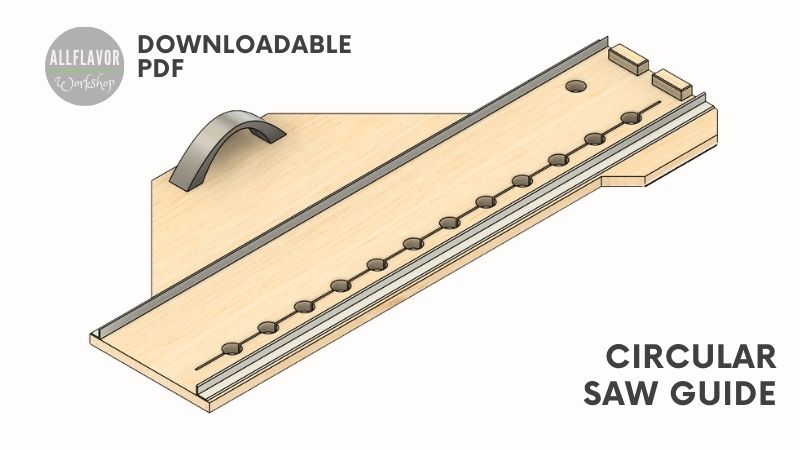
You can download the free circular saw guide rail plans if you want to follow the build with the main dimensions and part layout organized in one place.

This guide rail is built for my circular saw, so make sure to check the width and base shape of your own saw before cutting the parts. You may need to adjust the guide rail spacing to fit your model.

Download the free Circular Saw Guide Plans here

Free Downloadable Circular Saw Guide Plans

Materials and Tools

Before starting the build, prepare the materials and tools for the circular saw guide rail. This jig is mainly made from birch plywood, two aluminum guide rails, and a simple handle.

The dimensions below are based on my circular saw. Before cutting the parts, check the size and shape of your own circular saw base. The most important measurement is the width between the guide rails, because the saw needs to slide smoothly without too much side-to-side movement.

Check all the Tools I Use

Circular Saw Track

  • Birch Plywood – (700 x 335 x 12 mm)
  • 2x Birch Plywood – (35 x 25 x 12 mm)
  • Handle – 140 mm length
  • 4x wood screws
  • 2x Aluminum guide rails – (700 x 14 x 12 mm)
  • Hardware Assortment Kit – https://amzn.to/41PodgQ

Tools:

Other

Disclosure: Some of the links above are affiliate links. If you purchase through them, I may earn a small commission at no extra cost to you. Thanks for supporting AllFlavor Workshop.

📌 Pin this to Pinterest

DIY circular saw guide rail for making straight cuts in a small workshop
DIY circular saw guide rail for making straight, accurate cuts with a regular circular saw.

Quick Build Overview

Here is a quick overview of the circular saw guide rail before we get into the build. The jig is simple, but the spacing between the guide rails needs to match your circular saw so the saw can slide smoothly and cut accurately.

Item Details
Project DIY circular saw guide rail
Main use Making straight, controlled cuts with a circular saw
Overall size 700 mm × 335 mm
Main material Birch plywood base with aluminum guide rails
Guide rail length 700 mm
Saw fit Guide rail spacing needs to match your circular saw base
Difficulty Beginner-friendly
Best for Short straight cuts, small workshop projects, and cutting boards or panels more accurately
Plans Free downloadable plans available in the article

Before You Start: Circular Saw Guide Rails and Setup

Before building the jig, it helps to understand what a circular saw guide rail does and what to check before cutting the parts.

This is a simple jig, but the setup needs to match your circular saw. The guide rails should allow the saw to slide smoothly, stay straight, and keep the blade aligned with the cutting slot.

What Is a Circular Saw Guide Rail?

A circular saw guide rail is a straight guide that helps keep the circular saw on track while making a cut.

Instead of following a pencil line freehand, the saw slides between the guide rails and follows a fixed path. This makes it easier to get straight, repeatable cuts, especially when cutting plywood, boards, or panels.

Why Make a DIY Circular Saw Guide Rail?

The main reason is cost. Commercial guide rails and track saw systems can be expensive, especially when you are setting up a small workshop on a budget.

This DIY circular saw guide rail is much cheaper to build and uses simple materials: plywood, aluminum guide rails, basic hardware, and a handle.

It is also a good beginner project because the build is straightforward and does not require many tools.

How Accurate Is a Homemade Circular Saw Guide?

A homemade circular saw guide can be very accurate if the guide rails are straight, the saw fits well between them, and the jig is clamped securely before cutting.

The most important part is setting the aluminum rails to match your circular saw base. The saw should slide smoothly, but it should not have too much side-to-side movement.

Let’s Start Building

The circular saw guide rail is made from two main parts: the plywood base and the aluminum guide rails.

The base supports the circular saw and gives the jig its shape. The aluminum rails guide the saw so it moves in a straight line while cutting.

The overall size of my guide rail is 700 mm × 335 mm. This size works well for small workshop cuts, trimming boards, and making short straight cuts more accurately.

This guide rail was built for my Makita circular saw, but you can adjust the design for other circular saws too. Before cutting the parts, measure your own saw base and make sure the spacing between the guide rails matches your saw.

The most important part of the build is setting the guide rails correctly. The saw should slide smoothly between them, but it should not have too much side-to-side play.

How to make a Circular Saw Guide Track for a small workshop
The aluminum guide rails should be lower than the saw body at its lowest blade setting.
How to make a Circular Saw Guide Track for a small workshop
This helps keep the rails out of the way and allows you to use as much cutting depth as possible.

How to Make a DIY Circular Saw Guide Rail

Step 1: Make the Circular Saw Guide Base

Start by cutting the main base of the circular saw guide rail from 12 mm birch plywood. The base gives the jig its shape and supports the circular saw while it slides along the guide rails.

The overall size of my guide rail is 700 mm × 335 mm, but you may need to adjust the layout depending on your circular saw.

Before cutting the base, place your circular saw on the plywood and check the size of the saw base. This is important because the guide rails will later be positioned to fit your specific saw.

Draw the shape of the guide rail on the plywood and cut it out. I used a jigsaw together with a jigsaw guide rail, which worked well for this shape. You can also use a circular saw with a straight edge if you prefer.

After cutting the base, sand the edges and corners smooth. This removes splinters and makes the guide more comfortable to handle.

💡TIP: Do not rely only on the plan dimensions. Measure your own circular saw first and adjust the base layout if needed.

NOTE: The base does not need to be complicated, but it should be flat, stable, and large enough to support the saw during the cut.

How to make a Circular Saw Guide Track for a small workshop
Mark the shape of the guide rail on the plywood before cutting.
How to make a Circular Saw Guide Track for a small workshop
Drill a few holes for the jigsaw for easier access.
How to make a Circular Saw Guide Track for a small workshop
Cut the base from 12 mm birch plywood using a jigsaw or circular saw with a straight guide.
How to make a Circular Saw Guide Track for a small workshop
Use a jigsaw to easily cut around the design.
Making a Circular Saw Guide Track for a small workshop
Sand the edges and corners smooth before adding the aluminum guide rails.

Step 2: Attach the Aluminum Guide Rails

Now it’s time to attach the aluminum guide rails to the plywood base. These rails keep the circular saw moving in a straight line while cutting.

First, measure the width of your circular saw base. My circular saw base is 133 mm wide, but your saw may be different. Use your own measurement to set the distance between the two aluminum rails.

Cut the aluminum guide rails to length. For this guide, I used two aluminum rails, each 700 mm long.

Start with the first rail. Position it on the plywood base and attach it temporarily with double-sided tape. Once you are happy with the position, drill the holes and secure the rail with bolts, washers, and nuts.

Make sure the bolt heads are flush with the bottom of the base. The guide rail needs to sit flat on the workpiece, so nothing should stick out underneath.

To position the second rail, place the circular saw against the first rail and use the saw itself as a spacer. I added a small piece of tape to one side of the saw base to create a little extra clearance. This helps the saw slide more smoothly between the rails.

Once the second rail is positioned, attach it the same way with double-sided tape first, then drill and bolt it in place.

💡 TIP: The saw should slide smoothly between the aluminum rails, but it should not feel loose. A tiny bit of clearance is helpful, but too much side-to-side movement will make the cut less accurate.

NOTE: Thin aluminum rails can bend if you force them into position. Check that each rail stays straight before drilling and tightening the bolts.
Measuring the base of a circular saw
Measure your circular saw base before setting the spacing between the aluminum guide rails.
Building a circular saw guide track
Add a small piece of tape to one side of the saw base to create a little extra clearance.
Cutting guide rails for a circular saw guide
Cut the aluminum guide rails to match the length of the plywood base.
Building a circular saw guide track
Use double-sided tape to hold the first guide rail in place before drilling.
Building a circular saw guide track
Make sure the bolts head is flush underneath so the base sits flat on the workpiece.
Building a circular saw guide track
Secure the aluminum guide rails with bolts, washers, and nuts.
Making a DIY guide for a circular saw
Use the circular saw itself to set the spacing between the two guide rails.

Enjoying This Blog Post?

Join my newsletter to receive the latest news, tutorials, and project plans sent directly to your inbox!

Step 3: Cut the Saw Slot and Sight Holes

Once the aluminum guide rails are attached, place the circular saw on the track and cut the saw slot (not all the way through, just a shallow cut).

This guide rail does not have a stopper at the beginning or at the end. I made it this way to keep as much usable cutting length as possible. Just be careful when using it, because without a stopper it is possible to cut too far and damage the guide.

Start by placing the circular saw where you want the slot to begin. Set the blade depth shallow and make a light pass along the guide. This first shallow cut marks the blade path and shows exactly where the saw will cut.

Next, drill several sight holes along the slot line. I used a 20 mm Forstner bit for this. The sight holes help you position the guide rail over your pencil line when making cuts later.

After drilling the sight holes, cut the full slot with the circular saw. Take your time and keep the saw moving smoothly along the guide rails.

Once the slot is cut, sand the edges to remove splinters. I also sanded the top surface of the guide rail so the circular saw slides more easily.

💡 TIP: Cut the first pass very shallow. It gives you a clean reference line before cutting the full slot.

NOTE: Since this guide rail has no stopper, pay attention at the beginning and end of the cut. Do not push the saw too far past the usable cutting area.

Making a DIY guide for a circular saw
Position the saw carefully before making the first shallow cut.
Cutting a slot in a circular saw guide
Make a shallow pass first to mark the blade path.
Drilling sight holes in a circular saw guide rail
Drill sight holes along the slot so you can align the guide with your cut line.
Cutting a slot in a DIY circular saw guide rail
Cut the full slot after the sight holes are drilled.
Sanding a circular saw guide track
Sand the slot edges smooth to remove splinters and help the saw slide better.
Sanding a DIY circular saw guide
Sand the base surface help the saw slide better.

Ultra-Sharp Cutting Teeth Specifically Engineered To Cut Through Hard And Soft Woods Smoothly And Efficiently

Image: Amazon

Step 4: Attach the Handle

The last part of the build is adding the handle. This is optional, but I find it useful because it makes the circular saw guide rail easier to move, position, and hold while setting up the cut.

I used a 140 mm handle and attached it to the plywood base with screws. Before driving the screws in, pre-drill the holes to avoid splitting the plywood.

The handle I used did not give me enough space for my hand, so I added small plywood spacer pieces underneath. This raised the handle slightly and made it more comfortable to grip.

The handle helps when positioning the guide rail, but I still recommend using clamps when making cuts. Clamps hold the guide more securely and give you better accuracy.

💡 TIP: Test the handle position before attaching it permanently. Make sure your hand has enough space and that the handle does not interfere with the circular saw.

NOTE: The handle helps position the guide, but it should not replace clamps. For the cleanest and safest cuts, clamp the guide rail to the workpiece or workbench before cutting.

Attaching a handle on a circular saw guide rail
Small plywood spacers can raise the handle and give your hand more clearance.
Attaching a handle on a circular saw guide rail
Pre-drill the holes before attaching the handle to avoid splitting the plywood.
Attaching a handle on a circular saw guide rail
The handle makes the guide rail easier to position, but clamps are still recommended when cutting.

And this is how the finished circular saw guide track looks like.

A completed DIY Circular Saw Track Guide
Finished DIY circular saw guide rail for making straight, controlled cuts with a regular circular saw.
A completed guide for a circular saw
The completed circular saw guide track with aluminum guide rails, sight holes, and handle, ready for accurate workshop cuts.

How to Use a Circular Saw Guide Rail

Using the circular saw guide rail is simple, but the setup is important. The guide needs to be aligned with your cut line and clamped securely before you start cutting.

  1. Mark the cut line
    Draw a clear pencil line on the board or plywood where you want to make the cut.
  2. Secure the workpiece
    Clamp the board to your workbench so it cannot move while cutting.
  3. Position the guide rail
    Place the circular saw guide rail over the cut line. Use the sight holes to line up the blade slot with your pencil mark.
  4. Choose the correct side of the line
    Before clamping the guide, check which side of the line you want to cut on. This is important if your final piece needs to keep an exact size.
  5. Clamp the guide rail
    Clamp the guide rail to the workpiece or workbench. The guide should not move at all during the cut.
  6. Place the saw on the track
    Set the circular saw between the aluminum guide rails and check that it slides smoothly.
  7. Make the cut
    Start the saw, let it reach full speed, and slowly push it along the guide rail. Keep the saw steady and let the guide do the work.
  8. Support the offcut
    Make sure the offcut is supported so it does not pinch the blade or break away at the end of the cut.

💡 TIP: Use a scrap board or foam sheet under the workpiece if you are cutting through the full thickness. This helps protect your workbench.

NOTE: This guide rail does not have a stopper, so pay attention near the beginning and end of the cut. Do not push the saw too far past the usable cutting area

Using a DIY circular saw guide rail
Mark the cut line clearly before positioning the guide rail.
Using a DIY circular saw track guide
Use the sight holes to align the blade slot with your pencil line and clamp the guide rail securely so it cannot move during the cut.
A cut wooden piece with a circular saw guide track
The guide rail helps make cleaner and more accurate straight cuts with a regular circular saw.

Tips for Better Cuts

A circular saw guide rail helps a lot, but the final result still depends on how you set up the cut. These small details make a big difference.

Use a Sharp Blade
A good blade makes cleaner cuts and reduces tear-out. If your cuts look rough or burned, the blade may be dull or not suitable for the material you are cutting.

Clamp the Guide Rail Securely
Always clamp the guide rail before cutting. The handle is useful for positioning the jig, but clamps keep it from moving during the cut. Even a small shift can make the cut inaccurate.

Check the Cut Line Before Starting
Before turning on the saw, check that the blade slot is aligned with the correct side of your pencil line. This is important when cutting a piece to an exact final size.

Support the Workpiece
Support both the main piece and the offcut. If the offcut drops or pinches the blade near the end of the cut, it can affect the cut quality and make the saw harder to control.

Keep the Saw Moving Smoothly
Let the circular saw reach full speed before entering the cut. Then push it steadily along the guide rail without forcing it. If you push too fast, the cut can get rough. If you go too slowly, the blade may burn the wood.

Protect Your Workbench
When cutting through the full thickness of the material, place a sacrificial board, foam sheet, or support strips underneath the workpiece. This protects your workbench and gives the cut better support.

My Take

This circular saw guide rail is one of those simple workshop jigs that is definitely worth building, especially if you are working in a smaller shop or just getting started with woodworking.

It is easy to make, does not require many tools, and costs much less than buying a commercial circular saw guide rail or track saw system. For many basic workshop cuts, it gives you a much more controlled setup than cutting freehand.

The biggest thing to get right is the spacing between the aluminum guide rails. Once the saw fits well and slides smoothly, the jig is straightforward to use. Just line it up, clamp it down, and make the cut.

I also recommend using a good circular saw blade. The guide rail helps with accuracy, but the blade has a big impact on how clean the cut will be. If you save money by building the guide yourself, putting some of that money into a better blade is a good upgrade.

This version is best for shorter straight cuts, trimming boards, and small workshop projects. For longer cuts, sheet goods, or larger panels, you may also want to check out my other circular saw guides.

If you want to build this jig, you can download the free circular saw guide rail plans here.

You can also browse my woodworking plans page for more DIY jigs, workshop tools, and step-by-step woodworking projects.

More Circular Saw Jigs and Guides

This circular saw guide rail is a great jig for short straight cuts, but it is not the only circular saw guide worth building. Depending on the type of cuts you make most often, a different guide may be more useful.

If you want a jig that helps with short crosscuts, check out my circular saw guide and crosscut jig. It is useful for cutting boards to length and getting more repeatable 90-degree cuts with a circular saw.

Circular saw making a crosscut using a homemade crosscut jig.
The guide rail helps make cleaner and more accurate straight cuts with a regular circular saw.

For longer straight cuts, a straight edge guide is a better option. It is simple to build and works well for cutting plywood sheets, panels, and longer boards.

Circular saw making a rip cut on plywood using a shop-made straight edge guide.
The guide rail helps make cleaner and more accurate straight cuts with a regular circular saw.

A rip fence guide is helpful when you want to make repeatable rip cuts with a circular saw. It is a nice beginner-friendly jig and a useful accessory for small workshop projects.

A circular saw rip guide should be one of the woodworking jigs to have in a workshop. Learn step-by-step how to make a DIY circular saw rip fence.
The guide rail helps make cleaner and more accurate straight cuts with a regular circular saw.

Related Jigs Used in This Build

A few other workshop jigs helped me while making this circular saw guide rail. They are not required, but they can make the build easier, more accurate, and more comfortable.

Share this post with your friends
About the author, Lukas

Meet the creator of AllFlavor Workshop! As a passionate DIYer and woodworking enthusiast, Lukas is always looking for ways to make things himself rather than buying them off the shelf. With a keen eye for design and a knack for working with wood, Lukas enjoys sharing his craft with others and helping them discover the joy of building. Whether you're an experienced woodworker or a novice looking to try your hand at a new hobby, you're sure to find plenty of inspiration and tips on AllFlavor Workshop.