
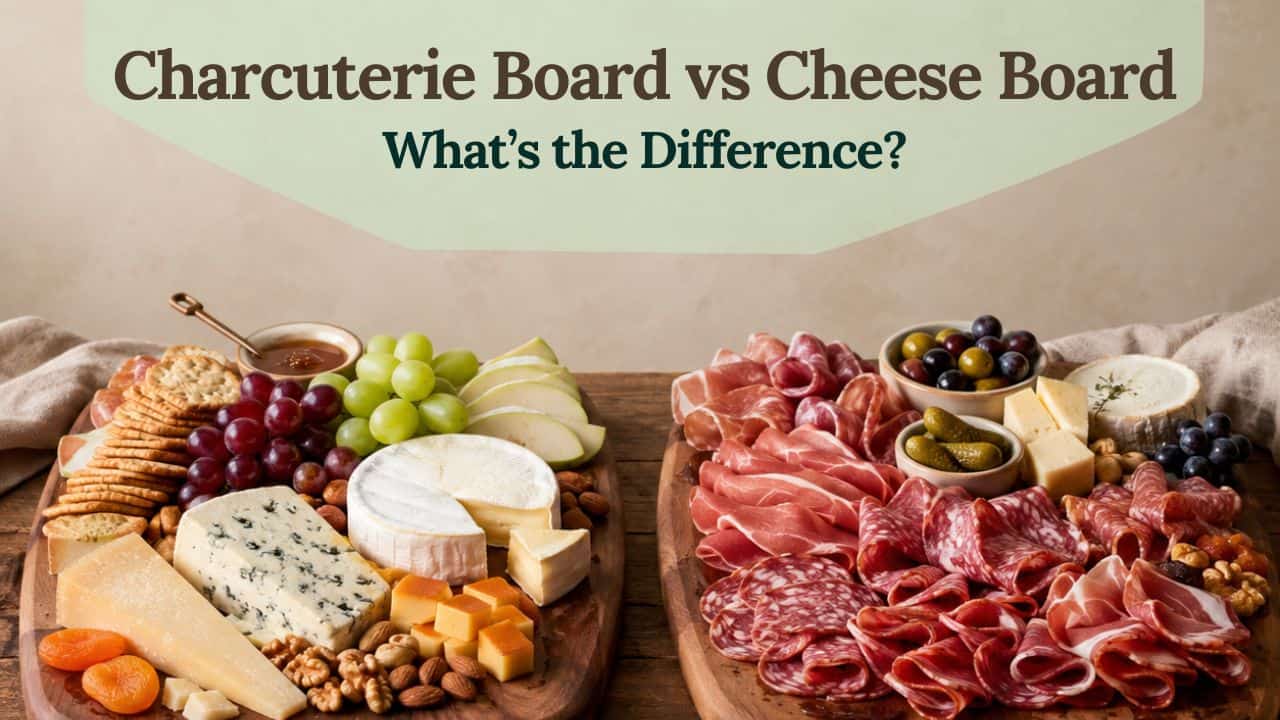
If you put a cheese board and a charcuterie board next to each other, there is a good chance the wooden boards themselves could be exactly the same.
That is probably the biggest difference between this comparison and something like a Charcuterie Board vs Cutting Board.
With a cutting board, the construction and intended use can be quite different. It needs to handle regular knife work, food preparation, washing, and repeated wear.
With a cheese board and a charcuterie board, the main difference is usually what you put on the board rather than how the board itself is built.
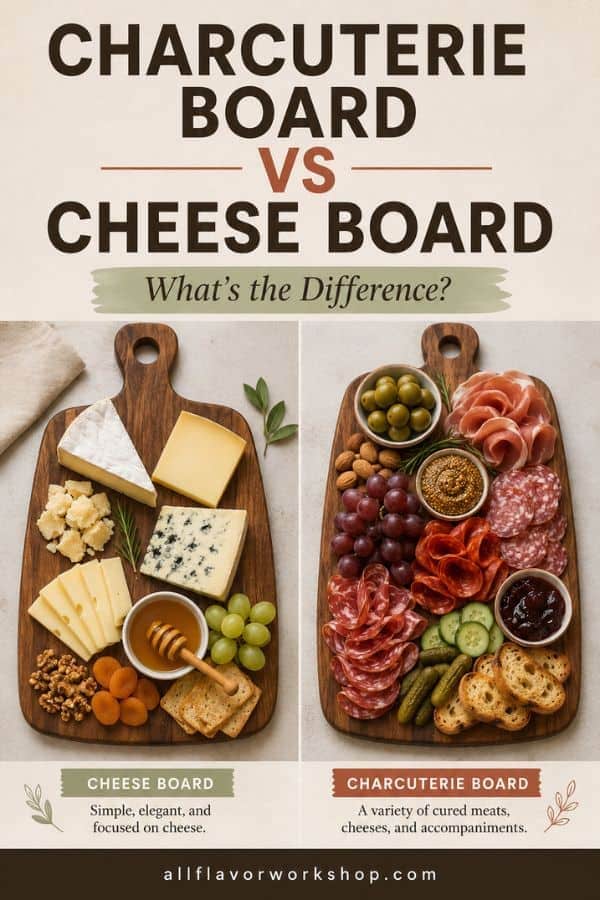
Traditionally, charcuterie is centered around prepared and cured meats. A cheese board, unsurprisingly, puts cheese at the center.
Today those definitions overlap a lot.
A typical modern charcuterie board may contain cheese, fruit, crackers, nuts, olives, and spreads alongside the meat. A cheese board may contain many of exactly the same things.
So from my woodworking perspective, I would not normally build a completely different wooden board for each one.
Instead, I would build a good serving board and let the food decide what we call it.
Table of Contents
- Charcuterie Board vs Cheese Board: Quick Answer
- What Is a Charcuterie Board?
- What Is a Cheese Board?
- What Is the Main Difference?
- Does the Wooden Board Itself Need to Be Different?
- What Size Board Would I Use?
- What Wood Would I Choose?
- Do You Need Handles, Grooves, or Other Features?
- Can You Use the Same Board for Both?
- What About Grazing Boards and Serving Boards?
- How I Would Build One Board for Both
- Wrap-Up
- Frequently Asked Questions
Charcuterie Board vs Cheese Board: Quick Answer
The simplest way I remember it is:
- Charcuterie board → meat is the main feature.
- Cheese board → cheese is the main feature.
Everything else can overlap.
| Feature | Charcuterie Board | Cheese Board |
|---|---|---|
| Main focus | Cured and prepared meats | Cheese |
| Cheese | Often included | Main ingredient |
| Cured meat | Main or important element | Optional |
| Fruit, nuts, crackers | Common | Common |
| Wooden board construction | Serving-focused | Serving-focused |
| Can the same board be used? | Yes | Yes |
In everyday use, the line can become very blurry.
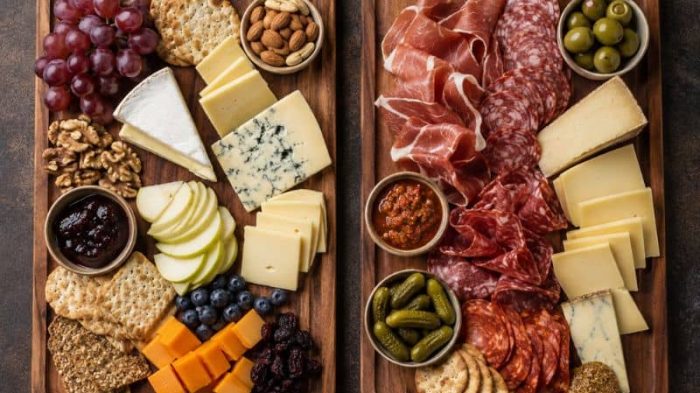
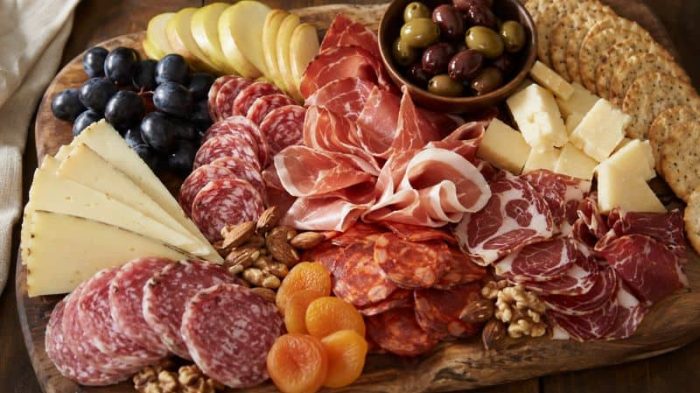
If I put three cheeses, salami, prosciutto, crackers, grapes, and nuts on one of my walnut boards, most people would probably call it a charcuterie board.
If I remove most of the meat and make the cheese the main feature, the same piece of wood suddenly becomes a cheese board.
What Is a Charcuterie Board?
The word charcuterie traditionally refers to prepared meat products, especially cured or preserved meats.
Think of foods such as:
- salami
- prosciutto
- cured ham
- sausages
- pâté
- terrines
A traditional charcuterie board therefore starts with the meat.
Cheese, bread, crackers, olives, fruit, nuts, pickles, and spreads can all be added around it.
Modern charcuterie boards have become much broader than that, though.
You will now see everything from breakfast charcuterie boards to dessert boards online. At that point, charcuterie board is often being used more as a description of the presentation style than of actual charcuterie.
For me, the traditional definition is still the easiest way to make sense of it:
If the meat is one of the main features, charcuterie is a good description.
What Is a Cheese Board?
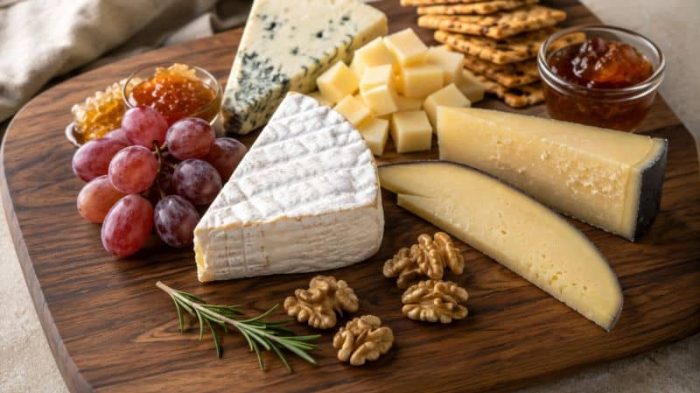
A cheese board puts cheese at the center of the spread.
That might mean combining:
- soft cheese
- hard cheese
- aged cheese
- blue cheese
- fresh cheese
with things such as:
- crackers
- bread
- grapes
- apples or pears
- dried fruit
- nuts
- honey
- jam
- olives
Meat can still appear on the board. It just is not the reason the board exists.
That distinction might sound small, but I think it is actually the cleanest way to separate the two.
A cheese board is not defined by the piece of wood underneath it. It is defined by what you are serving on it.
What Is the Main Difference?
If I reduce the whole article to one sentence:
A charcuterie board is centered around charcuterie; a cheese board is centered around cheese.
Everything around those main ingredients is flexible. That is why the two often look nearly identical in photographs.
| If the Spread Is Built Around... | I Would Usually Call It... |
|---|---|
| Salami, prosciutto, cured ham, pâté | Charcuterie board |
| Several cheeses | Cheese board |
| Meat + cheese equally | Usually charcuterie board |
| Fruit, vegetables, dips, bread, snacks | Grazing or serving board |
| Desserts or sweets | Dessert or grazing board |
I would not worry too much about getting the terminology perfect at home. If the food looks good and people enjoy it, the board has done its job.
From a woodworking point of view, the more useful question is: What kind of wooden board works best for serving all of these foods?
Does the Wooden Board Itself Need to Be Different?
Usually, no. This is where the woodworker’s perspective makes the comparison much simpler.
For both a cheese board and a charcuterie board, I generally want:
- a flat food-safe surface
- enough room for the food
- reasonably low weight
- comfortable edges
- an attractive grain pattern
- a finish suitable for direct food contact
- a shape that is easy to carry and put on the table
Those requirements are almost identical. Unlike an everyday cutting board, I do not need to design around constant chopping.
That gives me more freedom. I can use a thinner face-grain board, keep an interesting live edge, add a handle, or choose a shape mainly because I like how it looks.
That is exactly why decorative face-grain boards work so nicely for serving.
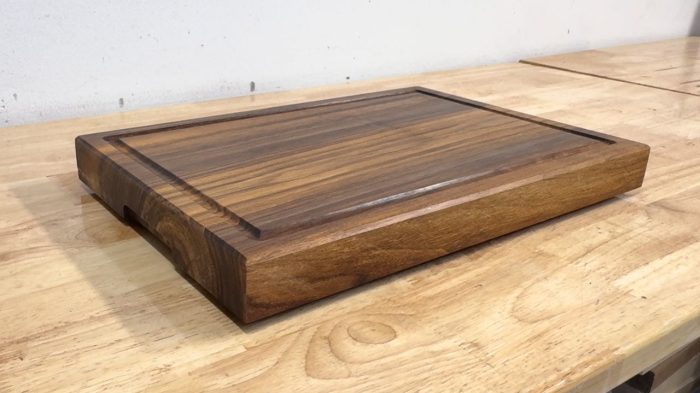
My DIY Face Grain Cutting Board is a good example. The walnut, live edge, and decorative details make it just as natural on the table as it is in the kitchen.
What Size Board Would I Use?
Size matters more than whether the board is labeled for cheese or charcuterie.
I choose the board based mainly on:
- how many people it needs to serve
- how many different foods I want to arrange
- whether I need space for small bowls
- how easily the loaded board can be carried
A smaller board works perfectly well for a few cheeses, crackers, and fruit.
A large charcuterie spread can fill a very large board surprisingly quickly.
A Useful Way to Think About Size
| Use | Board Approach |
|---|---|
| Small cheese selection for 1–2 people | Small, lightweight serving board |
| Cheese and snacks for a few people | Medium serving board |
| Full charcuterie spread | Medium to large board with plenty of flat area |
| Large gathering | Large board or several smaller boards |
For me, the last option is often overlooked.
One enormous board can become surprisingly heavy once it is covered in food.
Sometimes two medium boards are more practical than one huge one.
If you are choosing actual board dimensions, I go deeper into size and proportions in Cutting Board Sizes & Thicknesses.
What Wood Would I Choose?
For a serving board, appearance matters a lot. That is one reason I really like walnut.
It has a rich color, interesting grain, and looks especially good after applying oil or wax. Other woods I would comfortably consider include:
- maple
- beech
- cherry
I would still choose wood suitable for direct food contact even if the board will rarely see a knife.
The food sits directly on the surface, so I do not treat a serving board like ordinary decorative furniture.
If I wanted one board that could also occasionally be used for cutting, I would simply choose from the woods I already trust for cutting boards.
You can see those in more detail in Best Wood for Cutting Boards.
💡TIP: For a serving board, the grain pattern can influence my choice more than it would on a heavily used working board. A particularly nice face-grain walnut plank can become the feature rather than being cut into strips for edge or end grain.
Do You Need Handles, Grooves, or Other Features?
This is where I would design the board differently from a dedicated cutting board.
1. Handles
Handles make a lot of sense. A serving board may be completely covered with food by the time you carry it to the table.
Finger grips on the sides or an extended handle make that easier.
If you want to add them, I cover several approaches in How to Add Handles to a Cutting Board.
2. Juice Groove
I normally would not add one to a dedicated cheese or charcuterie board.
There is usually not enough liquid to justify giving up flat serving space around the perimeter.
The groove can also make it more awkward to position crackers, cheese, fruit, and other smaller items close to the edge.
I discuss that decision in more detail in Do You Need a Juice Groove? When It Helps and When It Doesn’t.
3. Rubber Feet
This one depends on how I want to use the board.
Feet can make the board more stable and easier to pick up, but they also turn it into a one-sided serving surface.
For a simple serving board, I often like the flexibility of keeping both sides usable.
4. Live Edge
This is one place where I think a serving board really benefits from having more design freedom.
A live edge can make a simple piece of walnut look much more interesting without getting in the way of the actual serving surface.
I am much more likely to keep that detail on a charcuterie or cheese board than on a heavily used everyday cutting board.
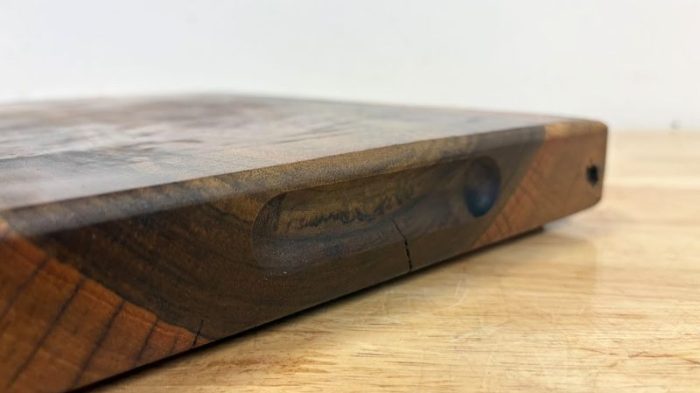
Can You Use the Same Board for Both?
Absolutely. If I were making a wooden board for my own kitchen, I would not build one and label it permanently:
CHEESE ONLY
and another:
CHARCUTERIE ONLY.
There is simply no need. The same walnut serving board can hold cheese one evening and meat, cheese, olives, and crackers the next.
The important things are that:
- the surface is food safe
- it is properly cleaned between uses
- the board is large enough
- the design works for serving
So if you are deciding which one to buy or build, I would choose the wooden board based on the size, wood, shape, and features you want — not the label.
That is very different from comparing a serving board with a dedicated working cutting board.
For that comparison, see Charcuterie Board vs Cutting Board: What’s the Difference?.
What About Grazing Boards and Serving Boards?
This is where the terminology gets even looser.
- A serving board is the broadest woodworking term for me. It describes the physical object without saying what food needs to be on it.
- A grazing board usually describes a larger mixed selection of foods arranged for people to snack on over time.
That could include:
- cheese
- meat
- vegetables
- fruit
- bread
- crackers
- dips
- sweets
- sandwiches
So I would think of it like this:
- Serving board = the wooden object.
- Cheese board = a spread centered on cheese.
- Charcuterie board = a spread centered on cured meats.
- Grazing board = a broader mixed spread.
The same physical board might become all four over its lifetime.
That is another reason I prefer building a versatile serving board instead of designing too narrowly around one label.
How I Would Build One Board for Both
If I wanted one wooden board specifically for cheese and charcuterie, I would keep the design quite simple.
I would probably choose:
- walnut, maple, beech, or cherry
- face-grain construction
- medium thickness
- generous flat serving area
- comfortable rounded or chamfered edges
- side finger grips or a simple handle
- no juice groove
- no permanent feet unless I specifically wanted them
- food-safe oil and wax finish
Most importantly, I would not make it unnecessarily heavy.
An end-grain board can look fantastic, but it is overkill for a serving board that rarely sees serious knife work.
Face grain lets the natural grain become part of the design and keeps the build simpler and lighter.
That is exactly the type of project where I think a beautiful piece of walnut should be allowed to look like a beautiful piece of walnut.
📌 Save THIS PIN to your Board on Pinterest!
Wrap-Up
A charcuterie board and a cheese board are different, but probably not in the way many people expect.
Traditionally, a charcuterie board is built around cured and prepared meats.
A cheese board is built around cheese.
The crackers, fruit, nuts, olives, bread, spreads, and other foods around them can overlap almost completely.
And from my woodworking perspective, the board underneath can be exactly the same.
I would not build a special wooden construction for cheese and another for charcuterie. I would build a good serving board from a suitable hardwood, give it plenty of flat space, keep it reasonably light, and let the food decide what it becomes that day.
That is also why I like simple face-grain boards for this type of project.
The grain can become part of the presentation, and there is no need to build the heavy-duty edge- or end-grain surface I might choose for serious everyday cutting.
If you want to understand how serving boards differ from working cutting boards, continue with Charcuterie Board vs Cutting Board: What’s the Difference?.
And if you want to build something that fits nicely between the two, my DIY Face Grain Cutting Board is a good example of a board that works naturally for both cutting and serving.
Frequently Asked Questions
What is the difference between a charcuterie board and a cheese board?
A traditional charcuterie board is centered around cured and prepared meats, while a cheese board is centered around cheese. Both can include crackers, bread, fruit, nuts, spreads, and other accompaniments.
Can I use a cheese board as a charcuterie board?
Yes. There is usually no need for a different physical wooden board. If the board is food safe and large enough, you can use the same serving board for cheese, charcuterie, or a mixture of both.
Does a charcuterie board have to include meat?
Traditionally, yes — charcuterie refers to prepared and cured meats. The term is now often used much more broadly for mixed food boards, but a board without charcuterie is more accurately described as a cheese, grazing, or serving board depending on what is on it.
Does a cheese board need a special type of wood?
No. I would use the same suitable food-safe hardwoods I normally use for serving or cutting boards, such as walnut, maple, beech, or cherry. For a serving board, appearance, weight, and grain pattern can play a bigger role in the choice.
Should a cheese or charcuterie board have a juice groove?
Usually not. A groove takes away flat serving space and is rarely necessary for cheese, cured meats, crackers, fruit, and similar foods. I normally prefer a completely flat surface for a dedicated serving board.
