
A beautiful piece of wood is not automatically a good cutting board material.
That is something worth thinking about before you start cutting strips, gluing panels, or spending hours flattening and sanding a board.
I have made cutting boards from several different woods over the years, including walnut, beech, ash, maple, and a few more decorative species. Some work very well as the main cutting surface. Others I would only use sparingly as accents — and there are materials I simply would not use at all.
For me, choosing wood for a cutting board comes down to more than just hardness or color. The grain structure, stability, food-contact suitability, glue behavior, and how the surface will hold up after years of knife use all matter.
That is also why I do not really like blanket rules such as “never use oak” or “any hardwood is fine.”
There is usually more to it.
If you are looking for the woods I actually recommend, start with Best Wood for Cutting Boards. In this article, I am going in the opposite direction — the woods and materials I would be cautious with, use only selectively, or avoid completely.
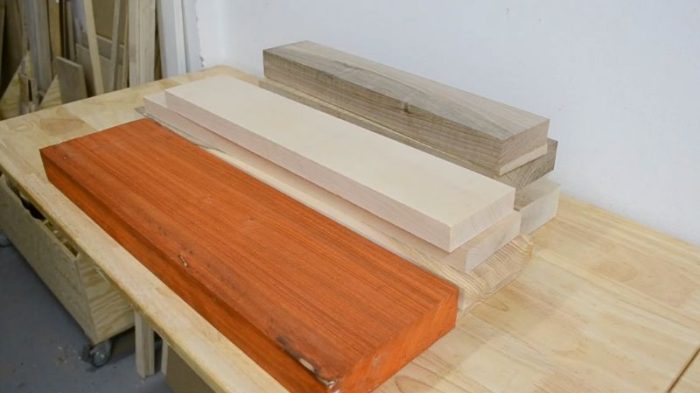
Table of Contents
- Quick Answer: What Woods Should You Avoid for Cutting Boards?
- What Actually Makes a Wood a Bad Choice?
- Softwoods: Pine, Fir, Spruce, and Cedar
- Open-Grain Woods: Oak and Ash Need More Nuance
- Unknown or Unidentified Wood
- Treated, Painted, or Reclaimed Wood
- Plywood, MDF, and Other Engineered Panels
- Exotic Woods: Not Automatically Bad, but Know What You Are Using
- Very Hard Woods Can Create Different Problems
- Woods I Would Use Instead
- My Simple Rule When Choosing Cutting Board Wood
- Wrap-Up
- Frequently Asked Questions
Quick Answer: What Woods Should You Avoid for Cutting Boards?
I would generally avoid using the following as the main cutting surface:
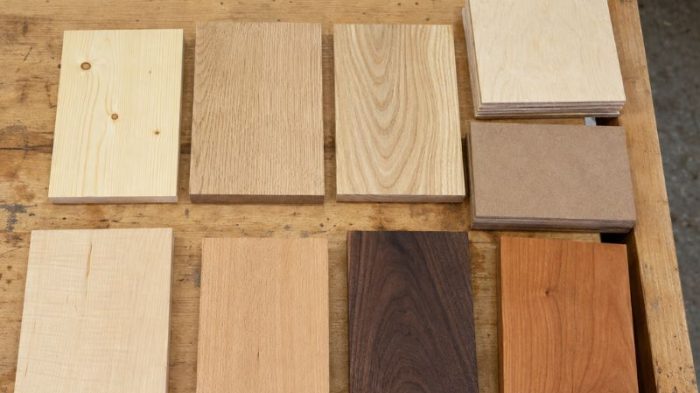
- very soft woods such as pine, fir, and spruce
- strongly aromatic softwoods such as cedar
- highly open-grained woods when easier alternatives are available
- treated, painted, stained, or chemically preserved wood
- wood of unknown species or origin
- plywood, MDF, particleboard, and similar engineered panels
- exotic species when I cannot confidently verify their properties and food-contact suitability
- extremely hard or abrasive woods that are unnecessarily harsh on knives
That does not mean every species in these groups is completely unusable.
For example, I have used ash as part of mixed-species cutting boards, and oak can make a beautiful accent.
The important distinction is between:
“Can this piece of wood technically be used?”
and
“Would I choose it as the main working surface when better options are available?”
Those are not always the same answer.
What Actually Makes a Wood a Bad Choice?
I think it is more useful to understand why a wood can be problematic than to memorize a list of species.
| Problem | Why It Matters |
|---|---|
| Very soft wood | Deep knife marks and dents appear quickly, making the surface harder to maintain. |
| Very open grain | Large pores can make the working surface harder to keep clean and smooth. |
| Unknown species | You may not know its toxicity, oil content, hardness, stability, or previous treatment. |
| Chemical treatment | Preservatives, paint, stain, or other chemicals may not be suitable for direct food contact. |
| Engineered material | Glue layers and fibers are exposed directly to moisture, knives, and food. |
| Extremely hard or abrasive wood | The surface may be durable, but it can be unnecessarily hard on knife edges and harder to machine. |
| Unstable stock | Poorly dried or unstable wood can cup, twist, or open glue joints after the board is finished. |
For my own boards, I am usually looking for the opposite: a stable, well-dried hardwood with reasonably tight grain that machines cleanly, glues well, and is not excessively hard on knives.
Softwoods: Pine, Fir, Spruce, and Cedar
I use softwoods for plenty of workshop projects. A cutting board is not one of them.
Pine, fir, spruce, and similar woods are simply too soft for the kind of repeated knife work a cutting board sees.
A sharp kitchen knife can leave deep marks surprisingly quickly. Over time, that creates a heavily damaged surface that is more difficult to keep smooth and clean.
Softwoods also tend to dent easily. That is not necessarily a problem for furniture or workshop storage, but on a cutting surface it becomes annoying very quickly.
Cedar Is an Even Easier No for Me
Cedar adds another issue: it is strongly aromatic. That smell is part of what makes cedar useful for things like storage and outdoor projects, but it is not something I want transferring to food.
So even if I had a beautiful cedar offcut in the shop, I would save it for another project.
💡TIP: Do not choose a cutting-board wood simply because you already have a large offcut. The amount of work that goes into a good cutting board usually makes buying a better piece of material worthwhile.
Open-Grain Woods: Oak and Ash Need More Nuance
This is probably the part where I disagree with some of the overly simple cutting-board advice online.
You will often read:
“Never use oak or ash for cutting boards.”
I think that is too absolute.
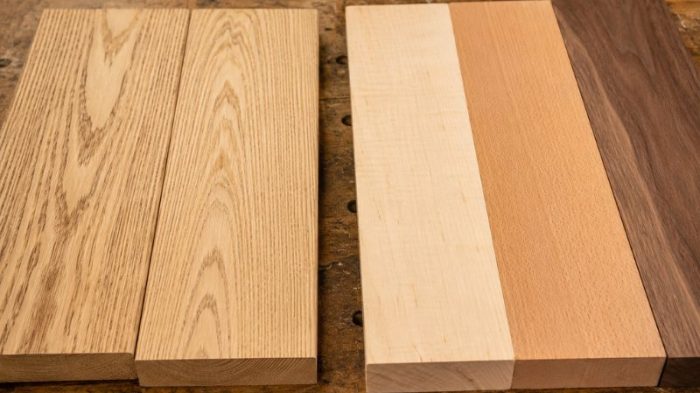
Both are open-grained woods with visible pores, and that does make them less attractive to me as a primary cutting surface compared with tighter-grained woods such as maple, beech, walnut, or cherry.
But that does not automatically make every piece of oak or ash unusable.
I have used ash in mixed-species boards because I like the contrast it creates. What I generally would not do is make the entire main working surface from ash when I have better options available.
The same thinking applies to oak.
What Is the Actual Issue?
Open-grain species have larger visible vessels in the wood. From a woodworking perspective, you can feel and see that difference when sanding and finishing the surface.
On something like furniture, those pores can look fantastic. On a cutting board, I prefer a tighter, smoother working surface that is easier to maintain.
So my approach is:
- Maple, beech, walnut, cherry → comfortable choices for the main surface.
- Oak and ash → species I would use more selectively, often as accents rather than the entire field.
This is the same approach I use in Best Wood for Cutting Boards.
Unknown or Unidentified Wood
This is one category I would avoid without much hesitation. If I find an old hardwood board somewhere and cannot confidently identify:
- the species
- where it came from
- whether it was treated
- what finish was applied
- what chemicals it may have been exposed to
…I would not turn it into a cutting board. Woodworking encourages reusing material, and I do that whenever it makes sense.
But a cutting board is a direct food-contact surface. This is one place where knowing what I am working with matters more than saving one piece of scrap.
A board sold simply as “hardwood” does not tell you enough either. If I am buying material specifically for a cutting board, I want to know the actual species.
Treated, Painted, or Reclaimed Wood
Reclaimed wood can make fantastic furniture. It can have dents, nail holes, saw marks, weathering, and character that would be impossible to recreate with fresh stock.
But those same unknowns make me cautious about using reclaimed wood for a cutting board.
I would avoid:
- pressure-treated lumber
- chemically preserved wood
- painted wood
- stained wood of unknown origin
- reclaimed construction timber with unknown history
- pallet wood when I cannot verify where it has been and what it carried
Even if you plane away the visible surface, you may still not know what the material has been exposed to.
For decorative woodworking, I am much more willing to experiment. For something that will regularly touch food, I keep it simple and use material I know.
Plywood, MDF, and Other Engineered Panels
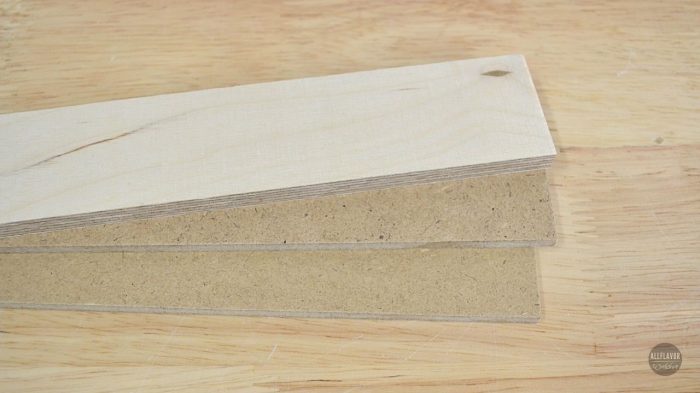
I use Baltic birch plywood and MDF constantly in my workshop. They are some of my favorite materials for building jigs. But I would never use them as the actual working surface of a cutting board.
Plywood
Plywood consists of multiple thin veneers glued together.
Once you start cutting into the surface and exposing the edges, you also expose glue lines and layers that are not designed to act as a chopping surface. Water can also work its way between those layers over time.
MDF
MDF is even less suitable. It is made from wood fibers and binders pressed together into a panel. Once moisture reaches damaged or exposed areas, MDF can swell badly.
A kitchen cutting surface is basically the opposite environment from what I want for MDF.
Particleboard and Similar Panels
The same logic applies. They are excellent materials for certain furniture or workshop jobs.
They are not materials I would put under a kitchen knife.
This is one of those cases where I think the answer is very simple: use solid hardwood.
Exotic Woods: Not Automatically Bad, but Know What You Are Using
I would not put every exotic wood into an “avoid” category. That would not make sense.
I have used woods such as padauk in cutting boards because I like the color contrast it creates. But with less familiar species, I do more homework before using them.
Things I want to understand include:
- known toxicity or irritation concerns
- whether the wood is unusually oily
- how well it glues
- how hard it is
- whether it contains a lot of silica
- whether the color or oils bleed into neighboring woods
- how it behaves during sanding and finishing
This is particularly important when making mixed-species boards. Just because a wood looks incredible next to maple does not mean I automatically want half the board made from it.
I Usually Use Strong Exotics as Accents
That is how I approach woods such as padauk or purpleheart.
A narrow stripe can completely change the look of the finished board without making that harder or more unusual species the main working surface.
It also makes the board easier to machine and usually cheaper to build.
NOTE: Dust safety and food-contact suitability are separate questions. A species can produce irritating dust while machining even if the finished wood is used in a board. Always control dust and use appropriate respiratory protection in the workshop.
Very Hard Woods Can Create Different Problems
It is easy to assume:
harder wood = better cutting board.
But that is not necessarily true.
A cutting board needs enough hardness to resist dents and wear, but I do not need the hardest material I can find.
If the wood becomes extremely hard or abrasive:
- machining becomes more difficult
- router bits and saw blades work harder
- burning becomes more likely
- sanding takes longer
- the finished board can be harder on knife edges
So I usually prefer something in the middle.
Hard maple, beech, walnut, and cherry all sit in a range that makes sense for the job.
They are durable without turning the cutting surface into something closer to a stone countertop.
Woods I Would Use Instead
If you are reading all of this and wondering what I actually recommend, the answer is not complicated.
| Wood | Why I Like It | How I Use It |
|---|---|---|
| Hard Maple | Tight grain, durable, clean working surface | Face, edge, and end grain boards |
| Beech | Affordable in Europe, fine grain, easy to machine | Main field or light-colored contrast |
| Walnut | Beautiful color, machines well, oils beautifully | Main boards and contrasting strips |
| Cherry | Fine grain, warm color, easy to work | Face and edge grain boards, accents |
| Ash | Strong grain contrast and easy availability | More selectively, often as an accent |
| Padauk / Purpleheart | Strong natural color | Small decorative accents rather than the main field |
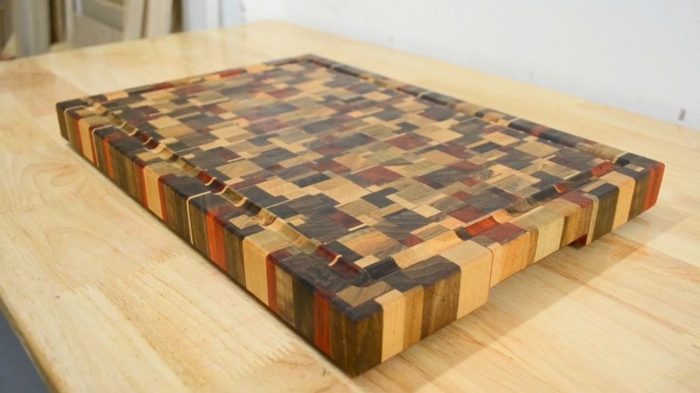
My own default choices are usually beech, walnut, maple, and cherry, depending on what is available and what look I want.
Availability also matters.
I am in Europe, where beech is usually easier and cheaper for me to get than it may be for someone in the US. Walnut tends to cost more, so I often combine species rather than making every board completely from walnut.
For the full comparison of the woods I actually use, see Best Wood for Cutting Boards.
My Simple Rule When Choosing Cutting Board Wood
When I am standing in the workshop choosing material for another cutting board, I do not make the decision based on one number.
I ask a few simple questions:
- Do I know exactly what wood this is?
- Is it suitable for direct food contact?
- Is the grain reasonably tight?
- Is it hard enough to survive everyday use without being unnecessarily hard on knives?
- Is the stock dry and stable?
- Will it glue and finish reliably?
- Would I be comfortable using this as the main working surface — or is it better as an accent?
If I cannot answer those questions confidently, I pick another piece of wood.
There are plenty of great cutting-board species available, so there is usually no reason to force the wrong material into the project.
And once you have selected the wood, preparation matters just as much. Straight stock, consistent thickness, and good glue surfaces make a huge difference to the finished board.
You can continue with How to Prep Wood for Cutting Boards if you want to see how I prepare stock before the actual glue-up.
📌 Save THIS PIN to your Board on Pinterest!
Wrap Up
There is no need to make cutting-board wood selection complicated.
But I also would not use a piece of wood simply because it is technically a hardwood or because it looks good.
For the main cutting surface, I prefer known, well-dried hardwoods with reasonably tight grain, good stability, predictable glue behavior, and a hardness that makes sense for everyday knife use.
That usually brings me back to woods such as maple, beech, walnut, and cherry.
Softwoods such as pine are too easy to damage. Unknown or treated lumber is not worth the uncertainty. Plywood and MDF belong in my jigs, not under my kitchen knife. And species such as oak, ash, or very hard exotics deserve a bit more thought rather than a simple yes or no.
That last point is probably the most important.
Not every less-than-ideal wood has to be completely banned from a cutting board. Sometimes the right answer is simply to use it differently.
I have used more unusual or open-grained woods as accents because a small strip can add plenty of character without making that species the entire working surface.
If you want to compare the woods I actually recommend in more detail, continue with Best Wood for Cutting Boards.
And once you have your material selected, the next step is How to Prep Wood for Cutting Boards.
Frequently Asked Questions
What woods should you avoid for cutting boards?
I generally avoid very soft woods such as pine, fir, and spruce; strongly aromatic woods such as cedar; treated or unidentified lumber; and engineered panels such as MDF and plywood. I am also more selective with very open-grained or extremely hard species.
Is oak bad for cutting boards?
I would not describe oak as automatically bad, but its open grain makes it less attractive to me as the main working surface compared with tighter-grained woods such as maple, beech, walnut, or cherry. I would be more comfortable using oak selectively or as an accent.
Can you use ash for a cutting board?
Yes, but I use it selectively. Ash has a relatively open grain, so it is not usually my first choice for the entire main cutting surface. I have used it successfully in mixed-species boards where it provides excellent visual contrast.
Is pine good for cutting boards?
I would not use pine for an everyday cutting board. It is soft and develops dents and deep knife marks much more quickly than suitable hardwoods such as maple, beech, or walnut.
Can you make a cutting board from plywood or MDF?
I would not. Plywood contains multiple glued veneer layers, while MDF is made from wood fibers and binders. Neither is intended to act as a direct, repeatedly cut and washed food-preparation surface. Solid hardwood is a much better choice.
