

Whether you are making a small wooden box, a kitchen tray, a drawer, or a simple storage chest, box joints are a great way to make strong and good-looking corners.
A box joint, also called a finger joint, uses a series of interlocking pins to connect two pieces of wood together. The joint gives you a lot of glue surface, which makes it strong, and it also creates a nice visible pattern on the corner.
There are several ways to cut box joints. You can use hand tools, a table saw with a box joint jig, or a router table with a router table box joint jig. For this build, I made a simple box joint jig that works as an add-on to my benchtop router table.
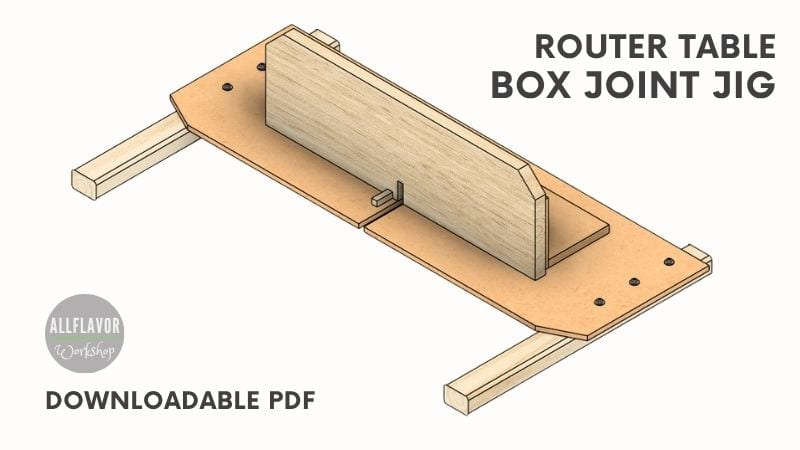
The jig slides over the router table using wooden guide rails and uses a stop pin to position each cut. Once the spacing is set correctly, you can cut clean and repeatable box joints without measuring every slot individually.
This build is made from HDF, Baltic birch plywood, spruce guide strips, and a small oak pin. It is not a complicated jig, but setup and accuracy matter — especially when positioning the front fence and testing the fit of the joint.
In this article, I’ll show you how to make a router table box joint jig step by step, how to set it up, and how to use it to cut clean box joint corners. I also have downloadable plans available if you want the dimensions and build details in a cleaner format while working in the shop.
This jig is part of my small router table system, together with the benchtop router table and router table spline jig.
DIY Router Table Box Joint Jig Video
If you want to see the full build process, watch the video below. I show how I make the sliding base, build the back and front fences, set the stop pin, test the box joint fit, and use the jig on the router table.
If you enjoy the video, I’d really appreciate it if you subscribed to my YouTube channel. It helps me keep creating more woodworking jigs, router table add-ons, and step-by-step build guides.
Table of Contents
- Box Joint Jig Video
- Router Table Box Joint Jig Plans
- Materials and Tools
- Quick Build Overview
- Before You Start: Box Joints, Finger Joints, and Router Bits
- What is the difference between a box joint and a finger joint?
- What router bit for box joints?
- How to Make a Router Table Box Joint Jig
- Step 1: Build the Sliding Base
- Step 2: Make the Back Fence
- Step 3: Make the Front Fence and Stop Pin
- Step 4: Test and Adjust the Box Joint Fit
- Step 5: Secure the Front Fence
- How to Use a Router Table Box Joint Jig
- Tips When Cutting Box Joints on a Router Table
- My Take
- FAQ
*Safety is your responsibility. Make sure you know what you’re doing and take all necessary safety precautions while working with power tools. Safety comes first!
Router Table Box Joint Jig Plans
I also offer a premium version of the Router Table Box Joint Jig plans, which includes:
✔ Metric and imperial measurements
✔ Detailed materials and hardware lists
✔ Exploded views and assembly drawings
✔ Additional build information and workshop tips
✔ Improvements and other resources
Browse all my premium woodworking plans.
Materials and Tools
Before starting the build, prepare the materials and tools for the router table box joint jig. This jig is mainly made from HDF, Baltic birch plywood, spruce guide strips, and a small oak pin that sets the spacing for the box joints.
I built this version as an add-on for my benchtop router table, so measure your own router table first and adjust the sliding base if needed.
Box Joint Jig
- Plywood – 310 mm x 100 mm x 12 mm
- HDF – 480 mm x 160 mm x 5 mm
- HDF – 2x (300 mm x 70 mm x 8 mm)
- Spruce wood strips – 2x (280 mm x 3 mm x 18 mm)
- Oak Pin
Check all the Tools I Use
Tools:
- Hand Drill – https://amzn.to/3HqLEnH
- Trim Router – https://amzn.to/3HbQcOg
- Table Saw / Mini Table Saw – https://amzn.to/47mWiGf
- One Hand Clamps – https://amzn.to/48jGxkZ
- Spring Clamps – https://amzn.to/41Nuh9D
Machinist Square / Speed Square - Calipers – https://amzn.to/3H3gnqC
Other:
- Wood Glue – https://amzn.to/48ltKhJ
- Wood Screws, Washers, Wing nuts – https://amzn.to/41PodgQ
- Straight router bit – 6mm – https://amzn.to/48nJmS1
- Spiral Router Bit* – https://amzn.to/3NS9lbY
A straight router bit works fine for cutting box joints, especially if you are just starting out. A spiral bit usually gives a cleaner cut and helps reduce tear-out, but it is more expensive.
Disclosure: Some of the links above are affiliate links. If you purchase through them, I may earn a small commission at no extra cost to you. Thanks for supporting AllFlavor Workshop.
📌 Save THIS PIN to your Board on Pinterest!

Quick Build Overview
Here is a quick overview of the router table box joint jig before we get into the step-by-step build. The jig is simple in principle, but the setup needs to be accurate because the stop pin controls the spacing of every box joint cut.
| Item | Details |
|---|---|
| Project | Router table box joint jig |
| Main use | Cutting clean, repeatable box joints and finger joints |
| Router table type | Built as an add-on for a benchtop router table |
| Finished size | About 480 × 280 × 130 mm |
| Main material | HDF, Baltic birch plywood, spruce guide strips, oak stop pin |
| Router bit | Designed around a 6 mm straight router bit; spiral bit optional |
| Difficulty | Beginner to intermediate |
| Best for | Wooden boxes, trays, drawers, small chests, and decorative corner joints |
Before You Start: Box Joints, Finger Joints, and Router Bits
Before building the jig, it helps to understand what a box joint is and why the setup matters. A router table box joint jig is simple in principle, but the spacing between the router bit and the stop pin controls the fit of the entire joint.
What Is the Difference Between a Box Joint and a Finger Joint?
A box joint and a finger joint are often used almost interchangeably, but there is a small difference in how people usually describe them.
- A box joint is made from a series of larger, square pins and slots along the edge of two boards. It is commonly used for wooden boxes, trays, drawers, and similar projects where you want a strong corner joint with a clean pattern.
- A finger joint is usually made from smaller, more delicate interlocking fingers. It is often used for joining longer pieces of wood together, especially when extending material length.
For this jig, the goal is to cut box joints on a router table, but many woodworkers will also call this type of setup a finger joint jig.
What Router Bit Should I Use for Box Joints?
For cutting box joints on a router table, a straight router bit or a spiral router bit works well. I used a 6 mm straight router bit for this jig.
A straight bit is simple, affordable, and works fine for most box joint cuts. A spiral bit usually gives a cleaner cut, removes chips better, and helps reduce tear-out, but it is more expensive.
The important thing is that the router bit size and the stop pin size need to match. If the bit is 6 mm, the stop pin should match that width so the pins and slots fit together correctly.
If you are just starting out, use a straight bit, make a few test cuts, and adjust the fence until the joint fits nicely by hand.
Let’s Start Building
The router table box joint jig works on a simple idea: the jig slides over the router table, and the stop pin controls the spacing between each cut.
The jig has three main parts: the sliding base, the back fence, and the front fence with the stop pin. The sliding base moves over the router table, the back fence supports the workpiece, and the stop pin sets the spacing for the box joints.
The most important part is the relationship between the router bit and the stop pin. If the spacing is right, the box joint should slide together by hand and hold firmly without being too tight.
I built this version for my benchtop router table and a 6 mm straight router bit. You can adapt the same idea to other router tables, but always adjust the jig around your router bit and stop pin.
How to Make a Router Table Box Joint Jig
Step 1: Build the Sliding Base
Start by measuring your router table first. My benchtop router table is 400 × 300 mm, so I made the sliding base slightly longer to leave an overhang on both sides.
Cut the HDF baseboard to size. For my jig, the base is 480 × 160 × 5 mm. The base should be long enough to slide smoothly over the router table and give you enough travel for the cut.
Next, cut two spruce guide strips and glue them to the underside of the HDF base. These strips wrap around the sides of the router table and keep the jig aligned while it slides forward and backward.
The easiest way to position the strips is to use the router table itself as a reference. Turn the router table upside down, align the HDF base, apply glue to the guide strips, and clamp everything in place. Once the glue dries, secure the strips with screws.
The base should slide easily over the router table, but it should not wobble. This fit is important because the jig needs to move straight and consistently during each cut.
💡TIP: If the base feels too tight, sand the inside of the guide strips lightly. If it has a little play, add painter’s tape to the strips until the fit improves.
NOTE: Measure your own router table before cutting the base. The dimensions in this build fit my benchtop router table, but the same idea can be adjusted to other router table sizes.


Step 2: Make the Back Fence
Now build the back fence of the box joint jig. This part supports the workpiece and keeps it square while cutting the box joint slots.
Start by gluing one HDF piece flat on the sliding base. Then glue the second HDF piece vertically on top of it to create the back fence. Use a machinist square or speed square to make sure the fence is perfectly perpendicular to the base.
Once the glue dries, mount the jig on the router table and cut a kerf in the base. Use the same router bit you plan to use for the box joints — I used a 6 mm straight router bit.
Slide the jig forward until the bit cuts through the base and reaches the back fence. This kerf shows the router bit path and will later help you position the front fence and stop pin correctly.
💡TIP: Take your time when squaring the back fence. If the fence is not perpendicular to the base, the box joint slots may not be straight.
NOTE: Cut the kerf using the same router bit size you will use for the final box joints. The bit size controls the width of each slot.


Find This Blog Post Useful?
Join my newsletter to receive the latest news, tutorials, and project plans sent directly to your inbox!
Step 3: Make the Front Fence and Stop Pin
Now make the front fence and add the stop pin. The stop pin is what makes the jig work — after each cut, the freshly cut slot fits over the pin and spaces the next cut automatically.
Temporarily clamp the front fence to the back fence. Then slide the jig over the router bit and cut a small kerf in the front fence for the stop pin.
The stop pin should match the width of the router bit. I used a 6 mm router bit, so the pin needs to be sized to fit the 6 mm slot. The pin should also protrude enough to support different workpiece sizes — around 20 mm is enough for this jig.
Glue the pin into the slot and make sure it sits flush with the bottom of the fence. Let the glue dry fully before testing the joint.
The fit of this pin is important. If it is too loose, the workpiece can shift. If it is too tight, it will be harder to move the workpiece from cut to cut.
💡TIP: Use calipers to check the stop pin thickness. It should closely match the router bit width so the pins and slots line up correctly.
NOTE: Don’t attach the front fence permanently yet. You still need to make test cuts and adjust the fence position until the box joint fit is right.


Step 4: Test and Adjust the Box Joint Fit
Before attaching the front fence permanently, make a few test cuts. This is where you fine-tune the jig and get the box joint fit right.
Mount the front fence on the jig and place a small spacer between the stop pin and the router bit. The spacer should be the same thickness as the stop pin and the router bit width. For this jig, that means 6 mm.
Clamp the front fence in place and set the router bit height. The bit should be slightly higher than the thickness of the workpiece. This way, the pins will protrude just a little after assembly and can be sanded flush later.
Make a few test cuts on scrap wood and check how the pieces fit together. The joint should slide together by hand and hold by itself. It should not be so tight that you have to force it, and it should not be loose.
👉 If the fit is too tight, move the front fence slightly toward the router bit. If the fit is too loose, move the front fence slightly away from the router bit. Make small adjustments, test again, and repeat until the fit feels right.
💡TIP: Always test the jig on scrap wood before cutting your real project parts. A small adjustment can make a big difference in the final fit.
NOTE: A little friction is good. The joint should slide together by hand, but still hold firmly before glue.


Step 5: Secure the Front Fence
Once the box joint fit looks good, you can secure the front fence permanently.
Keep the front fence clamped in the final tested position and double-check the fit one more time. If the test joint slides together nicely by hand and holds firmly, the fence is ready to be fixed.
Attach the front fence to the back fence with screws. Take your time and make sure the fence does not shift while drilling or driving the screws. This position controls the spacing between the router bit and the stop pin, so even a small movement can affect the final fit.
After the fence is secured, make another quick test cut to confirm nothing moved. If the joint still fits well, the jig is finished and ready to use.
Optionally, you can also add simple stoppers to the router table or jig travel path. They help prevent cutting too far and make the setup more controlled.
💡TIP: Keep the front fence clamped while drilling the screw holes. This helps prevent the fence from shifting out of its tested position.
NOTE: After attaching the fence permanently, make one final test joint. It is better to catch a small movement now than when cutting parts for a real box.

Below is the finished router table box joint jig. Once the front fence is secured and the test joint fits well, the jig is ready to use.
A box joint is one of my favorite corner joints. It is strong, repeatable, and looks great on wooden boxes, trays, drawers, and small workshop projects. With this jig, cutting the joint becomes much easier because the stop pin controls the spacing for each cut.

How to Use a Router Table Box Joint Jig
Once the jig is finished and tested, using it is quite straightforward. The stop pin controls the spacing, so after the first cut you simply move the freshly cut slot onto the pin and repeat the process.
For the best result, use scrap wood first and make sure the joint fits before cutting your final project pieces.
- Install the jig on the router table
Place the box joint jig over the router table and check that it slides smoothly without wobbling. - Set the router bit height
The router bit should be slightly higher than the thickness of the workpiece. This way, the pins will protrude just a little and can be sanded flush after assembly. - Make the first cut
Place the first board against the fence with its edge flush against the stop pin. Clamp the workpiece securely and make the first cut. - Move the board onto the stop pin
Place the freshly cut slot over the stop pin. This automatically spaces the next cut. - Repeat the cuts
Continue moving the board from slot to pin and cutting until you reach the end of the board. - Start the matching board
Flip the first board 180 degrees and place the slot closest to the router bit onto the stop pin. Then place the second board against the fence and tight against the first board. - Cut the matching side
Make the first cut on the second board, remove the first board, and continue the same slot-to-pin process until the second edge is finished. - Test the joint
Put both pieces together and check the fit. The joint should slide together by hand and hold firmly without being forced. - Glue and sand flush
Apply glue to the pins and slots, assemble the joint, and after the glue dries, sand the protruding pins flush with the surface.
TIP: When joining narrow pieces, make sure you have enough pins on both parts. Ideally, aim for at least two pins on each piece so the joint has enough strength.
NOTE: Always clamp the workpiece securely before cutting. Do not hold small pieces by hand close to the router bit.


Tips for Cutting Box Joints on a Router Table
Once the jig is set up correctly, cutting box joints is quite repeatable. Still, a few small details make a big difference in the final result.
- Aim for a snug fit, not a forced fit
The joint should slide together by hand and hold itself. If it is too tight, there will not be enough room for glue. If it is too loose, the joint will not be as strong. - Use glue on both pieces
Apply glue to the pins and the slots so the joint bonds properly. Don’t worry if some glue squeezes out — you can clean it up before sanding. - Use the right router bit
A straight router bit works well, but a spiral router bit can give cleaner cuts and reduce tear-out. For this jig, I used a 6 mm bit. - Use painter’s tape to reduce tear-out
Place painter’s tape on the exit side of the cut. This helps keep the edges cleaner, especially when routing across the grain. - Make test cuts first
Always test the setup on scrap wood before cutting your final project pieces. Small fence adjustments can change the fit a lot. - Sand the pins flush after assembly
Let the pins protrude slightly after glue-up. Once the glue dries, sand them flush with the surface for a clean finish.
My Take
I really like this router table box joint jig because it turns a simple benchtop router table into a much more useful joinery setup.
Box joints are one of my favorite corner joints. They are strong, they look good, and once the jig is dialed in, they are quite easy to repeat. The stop pin does most of the spacing work, so you don’t need to measure every single cut.
The most important part of this build is the setup. The sliding base should move smoothly over the router table, the back fence needs to be square, and the front fence must be adjusted until the box joint fit is right. Once that is done, the jig is simple to use.
This jig is especially useful for small boxes, trays, drawers, and similar projects. It is not a big or complicated jig, but it adds a lot of value to the router table.
This box joint jig is also part of my small router table system, together with the benchtop router table, router table spline jig, and router table tenon jig. If you are building a similar setup, this is a nice add-on to have in the workshop.
If you want to build this jig, you can follow the steps in this article and check my woodworking plans page for current and upcoming plans. I’m also preparing more detailed paid plans for my router table add-ons, so the build will be easier to follow directly from the workshop.
📌 Save THIS PIN to your Board on Pinterest!

FAQ
What is a router table box joint jig used for?
A router table box joint jig is used to cut clean and repeatable box joints or finger joints on a router table. It is useful for wooden boxes, trays, drawers, small chests, and other projects where you want strong decorative corners.
Can you cut box joints on a router table?
Yes, you can cut box joints on a router table with a box joint jig. The jig holds the workpiece against a fence and uses a stop pin to space each cut evenly. Once the jig is set correctly, you can repeat the cuts without measuring every slot.
What is the difference between a box joint and a finger joint?
A box joint usually has larger square pins and slots and is commonly used for boxes, drawers, and similar projects. A finger joint often refers to smaller interlocking fingers used for joining longer pieces of wood together. In woodworking, the terms are sometimes used interchangeably.
What router bit should I use for box joints?
A straight router bit or a spiral router bit works well for box joints. I used a 6 mm straight router bit for this jig. A spiral bit usually gives a cleaner cut and helps reduce tear-out, but a straight bit is a good and affordable option.
How tight should a box joint be?
A box joint should slide together by hand and hold firmly without being forced. If it is too tight, there may not be enough room for glue. If it is too loose, the joint will not be as strong.
