
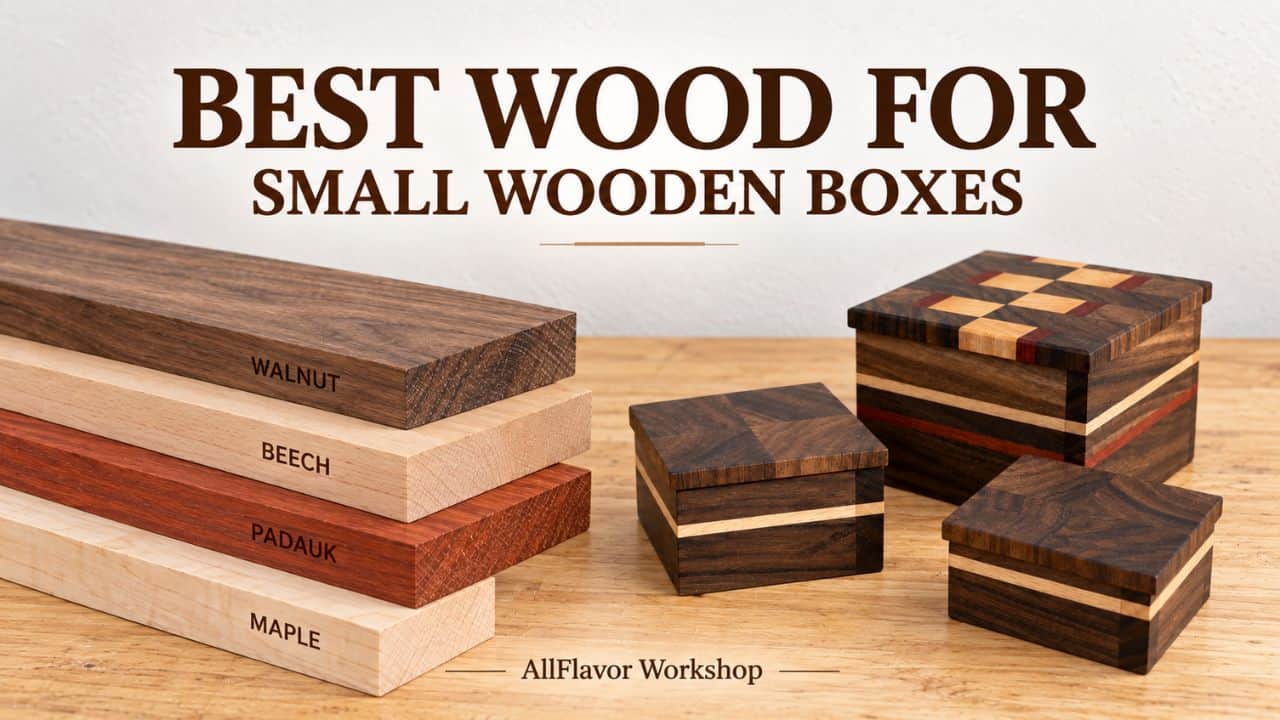
Small wooden boxes are a great way to use beautiful pieces of hardwood that may be too small for a larger project. But the wood you choose matters.
On a large piece of furniture, small imperfections in the grain or machining may disappear into the overall project. On a box that is only a few centimeters wide, every corner, grain line, joint, and color difference is much more visible.
That is why I usually prefer hardwoods that machine cleanly, hold crisp edges, sand smoothly, and look good without needing a complicated finish.
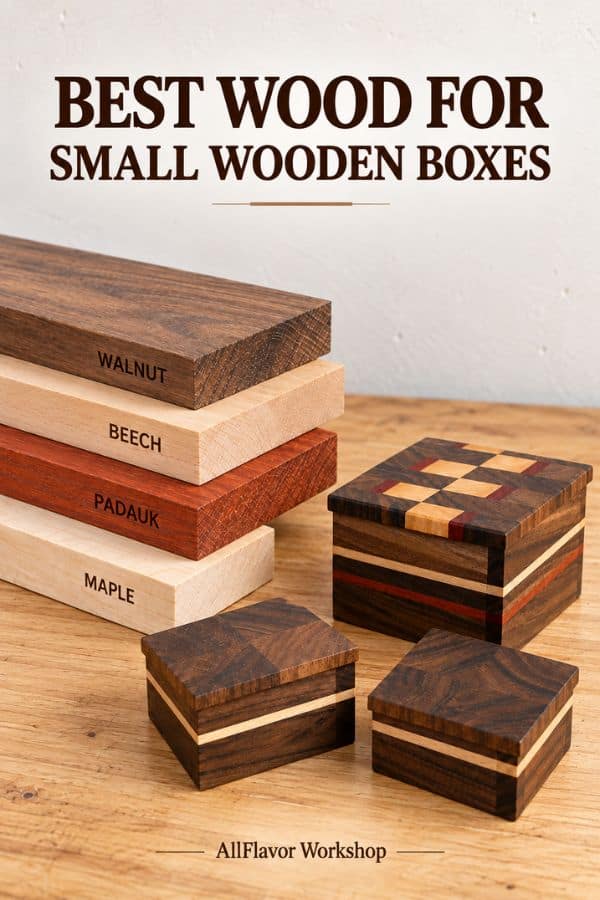
For my own boxes, I used walnut as the main wood, then combined it with beech, padauk, and ash for contrast. Walnut worked especially well because it gives even a very small box a rich, finished appearance without needing much decoration.
If you want to see those combinations in actual projects, have a look at my Small Wooden Keepsake Box and Decorative Wooden Box With a Patterned Lid.
But walnut is definitely not the only good choice. Let’s look at the woods I would consider first — and when I would use each one.
Table of Contents
- What Is the Best Wood for a Small Wooden Box?
- What Makes a Wood Good for Box Making?
- Best Woods for Small Wooden Boxes
- Walnut
- Maple
- Cherry
- Beech
- Ash
- Oak
- Padauk and Other Accent Woods
- Best Wood Depending on the Type of Box
- Woods I Would Use Carefully
- Combining Different Woods in One Box
- What I Used for My Own Boxes
- Wrap-Up
- Frequently Asked Questions
*Safety is your responsibility. Make sure you know what you’re doing and take all necessary safety precautions while working with power tools. Safety comes first!
What Is the Best Wood for a Small Wooden Box?
If I had to narrow it down to three woods, I would start with: Walnut, cherry, and maple.
All three can produce a clean, refined small box, but each gives you a very different look.
- Walnut is my favorite when I want something dark and decorative.
- Cherry gives you a warm reddish-brown appearance and is particularly nice to machine.
- Maple gives you a much lighter, cleaner look and works especially well when you want sharp contrast against darker woods.
Black walnut is generally easy to work, glues and finishes well, and is also known for good dimensional stability. Cherry has a fine, even texture and is particularly well regarded for its workability and stability. Hard maple also has a fine, even texture, although its higher density can make it a little more demanding to machine.
Here is how I would compare the main options:
| Wood | Appearance | Workability | Best Use | My Take |
|---|---|---|---|---|
| Walnut | Dark brown, rich grain | Very good | Keepsake and decorative boxes | My first choice for a darker premium-looking box |
| Maple | Light, clean, fine grain | Good, but harder | Modern boxes and contrasting details | Excellent when you want crisp, light-colored parts |
| Cherry | Warm reddish brown | Excellent | Keepsake and gift boxes | One of the nicest all-around box-making woods |
| Beech | Pale, subtle grain | Very good | Light boxes and accent strips | Especially useful for contrast with dark walnut |
| Ash | Light with stronger grain | Good | Patterned lids and decorative details | Good when you want the grain itself to be visible |
| Oak | Strong, open grain | Good | Rustic or traditional boxes | Usable, but not my first choice for tiny refined boxes |
| Padauk | Red-orange when freshly cut | Generally good | Accent strips and patterned lids | I prefer it as a contrast wood rather than the whole box |
What Makes a Wood Good for Box Making?
There is no single property that makes a wood perfect for a small box. I look at a combination of several things.
Clean Machining
Small parts make tearout and rough edges much more noticeable. A wood that cuts, routes, and sands cleanly makes it easier to create neat corners and fitted lids.
Grain and Texture
Fine- and medium-textured woods generally look especially good on small projects because the grain stays proportional to the size of the object.
Very open-grained woods can still look great, but their texture becomes a much stronger part of the design. For example, hard maple has a fine, even texture, while red oak has a much coarser and more open grain.
Stability
A small fitted lid may only have a tiny amount of clearance. If the wood moves significantly as humidity changes, a lid that fits perfectly today may become noticeably tighter or looser later.
You cannot eliminate wood movement, but starting with properly dried, stable stock and choosing suitable grain orientation certainly helps.
Appearance
For a small box, this is a big one. You may only be looking at a side panel 30–50 mm (about 1-3/16–2 in) high, so the grain and color need to work at that scale.
That is one reason I like walnut so much. Even a small piece can have enough natural variation to make the box interesting without adding complicated joinery or hardware.
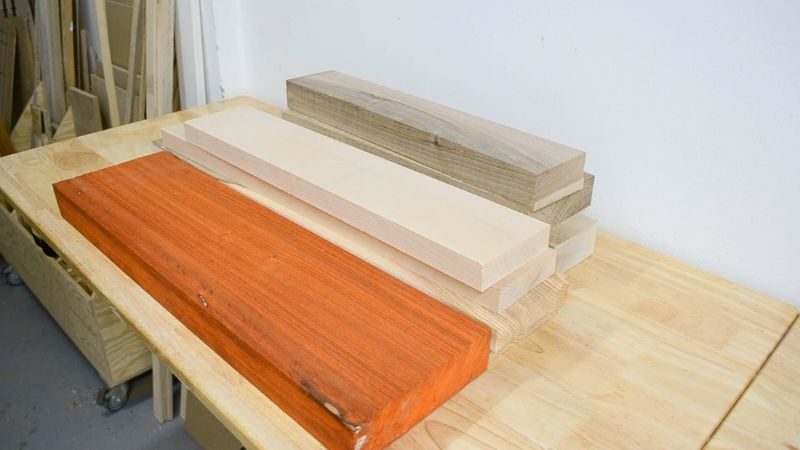
Best Woods for Small Wooden Boxes
1. Walnut
Walnut is probably my favorite overall wood for small keepsake boxes.
The heartwood ranges from lighter brown through dark chocolate brown, sometimes with darker streaks or reddish and purple tones. It usually has a medium texture and is generally easy to work with when the grain is reasonably straight. It also glues and finishes well.
For a small box, I especially like that walnut already looks decorative on its own.
- You do not need stain.
- You do not need complicated inlays.
A simple walnut box with a well-selected grain pattern can already look finished and intentional. It also works extremely well with lighter woods.
Some combinations I like are:
- walnut + beech
- walnut + maple
- walnut + ash
- walnut + padauk
- walnut + cherry
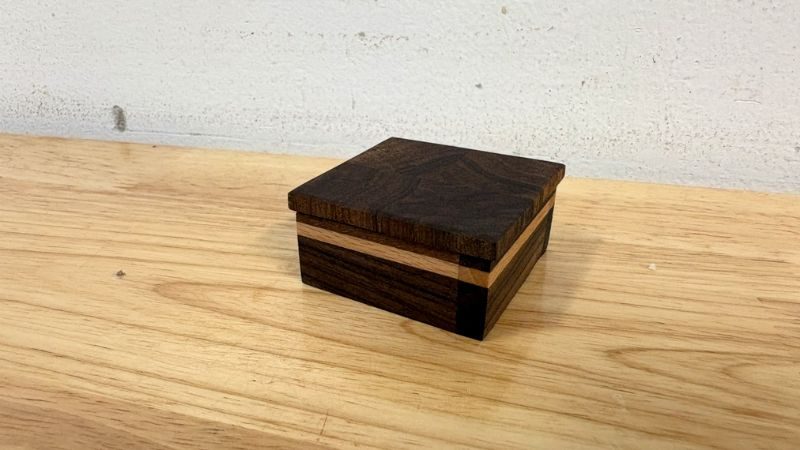
For my smaller boxes, I used dark walnut with a narrow beech strip. The design is simple, but the contrast becomes very clear once the finish goes on.
BEST FOR: Keepsake boxes, jewelry boxes, gift boxes, patterned lids, and boxes where the wood itself should be the main feature.
💡TIP: Before cutting your small box parts, look at the grain rather than only trying to minimize waste. On a tiny box, moving the layout just a few centimeters can give you a much better-looking side or lid.
2. Maple
Maple is almost the opposite of walnut visually. It is light, clean, and much more subtle.
Hard maple generally has a fine, even texture and is fairly easy to work, although its greater density makes it more demanding than soft maple. It can also burn when routed with high-speed cutters, especially if the cutter is dull or the feed rate is too slow.
For box making, that fine texture is a major advantage. Edges can look very crisp, and the light surface works beautifully beside walnut or another dark hardwood.
Soft maple is also worth considering. Despite the name, common soft-maple species can have hardness in roughly the same range as respected cabinet woods such as walnut and cherry, while generally being easier to machine than hard maple.
BEST FOR: Modern boxes, light-colored boxes, contrasting lids, and geometric patterns.
NOTE: If you are routing a fitted lid from hard maple, take light passes and keep the cutter sharp. Burn marks are much easier to prevent than sand out from a tiny routed shoulder.
3. Cherry
Cherry is one of the woods I would choose if I wanted a box that looks traditional but still clean and refined. Fresh cherry starts lighter and gradually darkens toward a warmer reddish brown with exposure to light.
It has a fine, even texture and is known for very good overall workability. It machines well and is also considered reasonably stable.
That combination makes it particularly suitable for small projects. You get a hardwood that is pleasant to machine but still capable of producing sharp, refined parts. The only thing to remember is that cherry’s appearance changes with time.
That is not necessarily a downside — in many projects, it is one of the reasons people choose it.
BEST FOR: Keepsake boxes, gift boxes, jewelry boxes, and traditional-looking projects.
4. Beech
Beech is much lighter than walnut and has a fairly uniform appearance.
It machines, glues, finishes, and turns well. Its texture is generally fine to medium and uniform. However, beech also has comparatively substantial movement in service, so wood movement needs to be considered when designing close-fitting components.
For my boxes, I especially like it as an accent wood.
A narrow beech strip through dark walnut gives you a very clear contrast without dominating the design. That is exactly what I did on my Small Wooden Keepsake Box.
You could certainly make an entire box from beech, but visually I think it becomes more interesting when paired with something darker.
BEST FOR: Light-colored boxes, laminations, accent strips, and contrasting details.
5. Ash
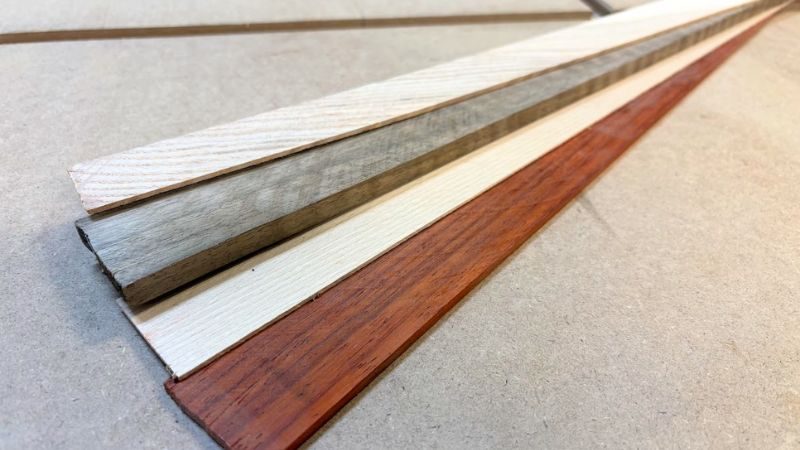
Ash is another light-colored hardwood, but visually it is quite different from maple or beech. Its grain is stronger and its texture is medium to coarse. White ash generally machines well and also glues and finishes well.
I used ash in the patterned lid of my decorative box. There, the stronger light grain works well because it sits next to dark walnut and red padauk. Instead of disappearing into the pattern, it remains clearly visible.
I would choose ash when I want the grain itself to become part of the design. If you want a very smooth, quiet, almost minimal-looking box, maple may suit the project better.
BEST FOR: Patterned lids, contrasting inserts, decorative boxes, and projects where visible grain is an advantage.
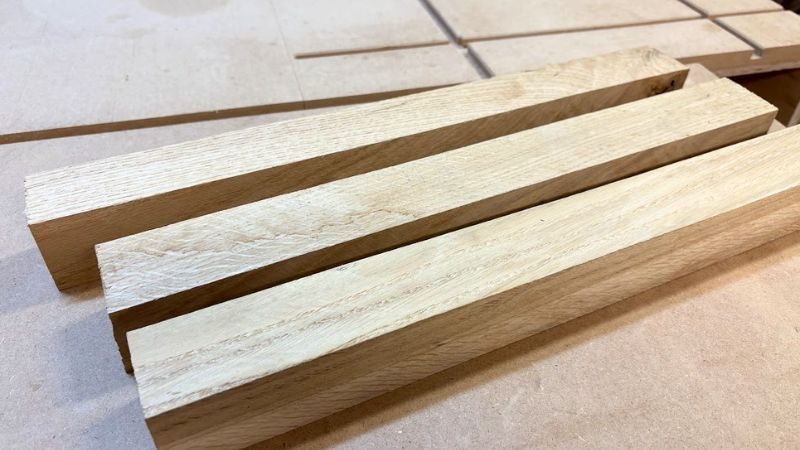
6. Oak
Oak can absolutely be used for boxes. I just would not automatically choose it for the very small boxes I tend to make.
Red oak has a coarse, uneven texture with very open pores. It machines well overall, but its relatively high shrinkage gives it only mediocre dimensional stability compared with some of the other woods here.
On a larger rustic or traditional box, that strong grain can look excellent. On a very small 45 mm (about 1-3/4 in) wide keepsake box, however, the grain may visually dominate the entire project.
That makes oak more of a design choice than a default recommendation for me. If that is the appearance you want, use it. If you want a fine, smooth, refined little box, I would normally reach for walnut, cherry, or maple first.
BEST FOR: Rustic boxes, larger boxes, traditional designs, and projects where open grain is part of the look.
7. Padauk and Other Accent Woods
Padauk is one of the easiest ways to add strong color without using paint or stain.
Fresh African padauk is usually a vibrant reddish orange and gradually darkens toward reddish or purplish brown with age and light exposure. Its texture is comparatively coarse and open, and it generally works and glues well, although interlocked grain can sometimes tear out.
I used it in two places on my decorative box:
- as a narrow strip running around the sides
- as part of the patterned lid
That is how I generally prefer to use woods like padauk. A small amount gives you a strong visual effect. You do not necessarily need to build the entire box from it.
NOTE: Padauk will not stay the exact bright orange-red color it has when freshly machined. Expect it to darken over time.
BEST FOR: Accent strips, patterned lids, small inlays, and contrasting decorative details.
📌 Save THIS PIN to your Board on Pinterest!
Best Wood Depending on the Type of Box
The best wood also depends on what kind of box you are trying to make.
| Box Style | Woods I Would Consider | Why |
|---|---|---|
| Small keepsake box | Walnut, cherry, maple | Clean machining and a refined appearance |
| Jewelry box | Walnut, cherry, maple | Fine appearance and good detail at small scale |
| Decorative box | Walnut + ash + padauk | Strong color and grain contrast |
| Light modern box | Maple, beech, ash | Light colors and clean appearance |
| Rustic box | Oak, ash | Strong, visible grain |
| Beginner practice box | Pine or inexpensive hardwood | Lower-cost material for learning the construction |
This does not mean you cannot mix things up.
- A walnut box can look modern.
- A maple box can look traditional.
These are simply the combinations I would consider first.
Woods I Would Use Carefully
There are very few woods that I would say you absolutely cannot use for a small wooden box. But some require more thought.
Pine
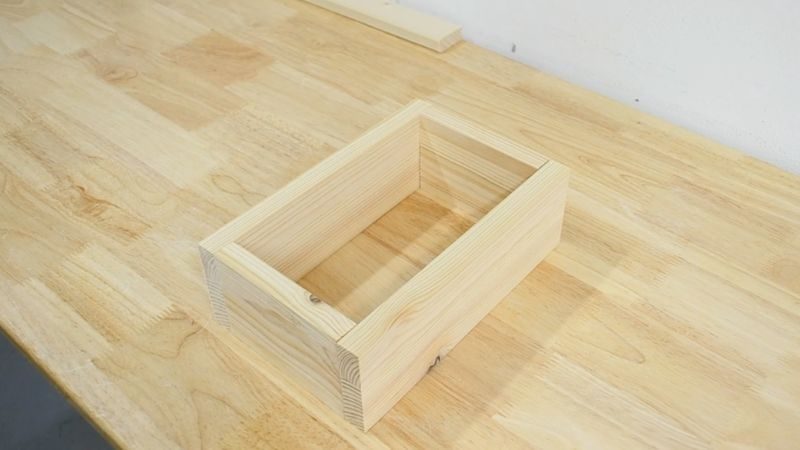
Pine is inexpensive, easy to work with, and perfectly capable of making a wooden box. In fact, it is a very good learning material.
My How to Make a Wooden Box project is a good example of a simpler box where there is no need to start with expensive hardwood.
The downside is softness.
For example, Eastern white pine has a Janka hardness of only about 380 lbf, so it is considerably easier to dent than the hardwoods discussed above. Janka hardness measures resistance to indentation and is useful when considering how easily a wood may pick up dents and wear.
For a practice box, that may not matter at all.
For a small keepsake box that you want to look crisp and refined for years, I would normally choose hardwood.
Very Coarse-Grained Woods
Coarse grain is not inherently bad. The question is whether it suits the scale.
On a very small box, huge pores and strong grain lines can easily become the main visual feature. If that is intentional, great. If you want the box to look smooth and refined, a finer-textured wood may make life easier.
Highly Figured Wood
Figured walnut, curly maple, and similar pieces can look fantastic. But irregular grain can also make planing and routing more difficult.
For example, irregular or figured walnut can be more prone to planer tearout.
For a small lid, I would absolutely use beautiful figured wood if I had it. I would just take lighter cuts and pay more attention to grain direction.
Combining Different Woods in One Box
This is probably my favorite way to make a small box more interesting. You do not necessarily need complicated joinery or expensive hardware.
Sometimes one narrow strip of contrasting wood is enough. Think about the contrast in three ways:
Dark + Light
This is the easiest combination to make work. Examples:
- walnut + beech
- walnut + maple
- walnut + ash
The dark body stays dominant while the lighter strip creates a clear line.
Dark + Color
This gives you a stronger decorative effect. For example:
- walnut + padauk
That is what I used in my decorative box.
Three-Wood Patterns
For a lid, you can go further. My patterned lid combines:
- walnut + padauk + ash
The walnut provides the dark background, ash adds the light contrast, and the smaller padauk pieces add red highlights.
You can see the complete box in How to Make a Decorative Wooden Box With a Patterned Lid.
💡TIP: When combining several woods, choose one as the main species and let the others support it. Too many woods in equal amounts can make a very small project look busy.
What I Used for My Own Boxes
For my two smaller keepsake boxes, I kept the combination very simple. The body is made from the darker part of walnut, with a narrow beech strip running around the sides. I intentionally placed the strip above the center rather than directly through the middle.
Once the boxes were finished with oil, the walnut became much darker while the beech remained light, making that thin stripe much more noticeable.
You can see that full build in How to Make a Small Wooden Keepsake Box.
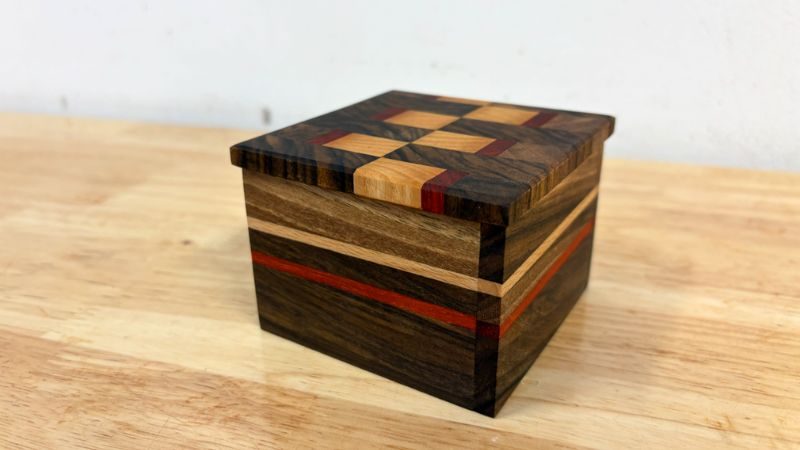
For the larger decorative box, I wanted more contrast. I used:
- Body: walnut + padauk + walnut + beech + walnut
- Lid: walnut + padauk + ash
The lid was built using a similar idea to an end-grain cutting board, where several pieces are glued, cut, rearranged, and glued again into a decorative pattern.
You can see that project in How to Make a Decorative Wooden Box With a Patterned Lid.
These two projects are also a good example of why I would not look for one single “best” box wood. The main material can stay the same while a few small accent pieces completely change the appearance.
Wrap-Up
So, what is the best wood for small wooden boxes? For me, walnut is the easiest answer.
It machines well, has enough natural character to look good without stain, works beautifully with lighter accent woods, and suits everything from a simple keepsake box to a more decorative design. Its working characteristics and dimensional stability also make it a strong choice for small wooden objects.
But it is not the only good option.
- Cherry would be high on my list if I wanted a warm, traditional-looking box.
- Maple would be one of my first choices for a light, clean design.
- Beech and ash are especially useful when I want contrast.
- And padauk is one of my favorite woods for adding just a small amount of natural color.
I would choose the wood based on the look of the finished box first, then think about how the grain, texture, stability, and machining characteristics fit the construction.
And if you have several small hardwood offcuts in the workshop, a box is one of the best projects for putting them to use.
Frequently Asked Questions
What is the best wood for making a small wooden box?
Walnut, cherry, and maple are all excellent choices. I personally prefer walnut because it machines well, has a rich natural color, and works especially well with contrasting accent woods such as beech, maple, ash, and padauk.
Is walnut good for wooden boxes?
Yes. Walnut is generally easy to machine, glue, and finish, and it has good dimensional stability. Its dark brown color and natural grain also make it particularly suitable for small decorative projects.
Is pine good for a keepsake box?
Pine can be used and is especially useful for inexpensive practice projects. It is much softer than hardwoods such as walnut or maple, however, so it will dent more easily. For a refined keepsake or jewelry box, I usually prefer hardwood.
What wood is best for a jewelry box?
Walnut, cherry, and maple are all strong choices. Walnut gives you a darker appearance, cherry produces a warmer reddish tone, and maple works well for a clean, light-colored box.
Can I combine different woods in one wooden box?
Yes. Contrasting woods can be one of the easiest ways to make a small box more decorative. I like combinations such as walnut and beech for a simple contrast, or walnut, padauk, and ash when making a more detailed patterned lid.
