
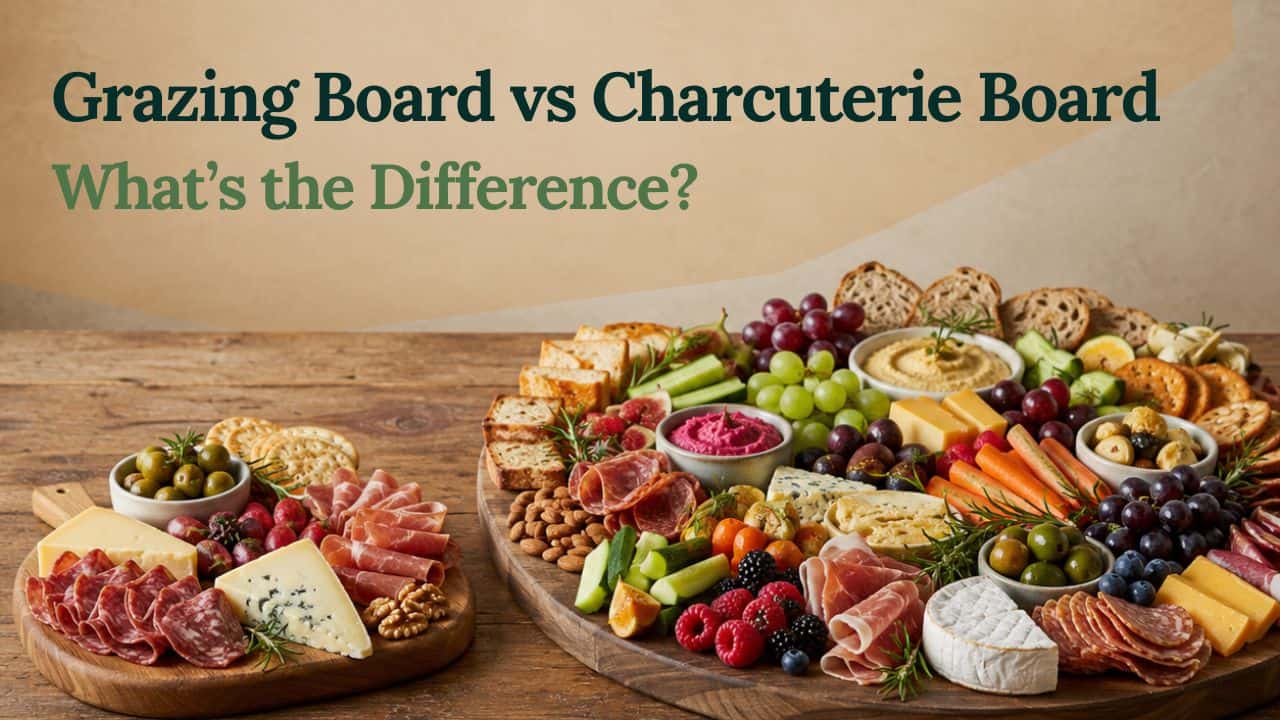
A grazing board and a charcuterie board can look very similar, especially once you start adding cheese, fruit, crackers, nuts, dips, and other snacks around the main ingredients.
But there is a useful difference between them.
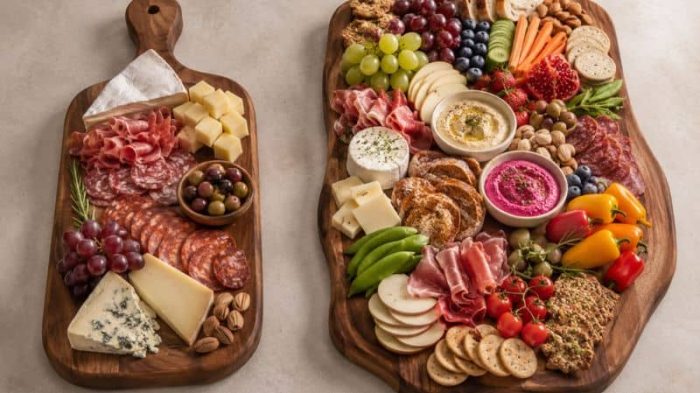
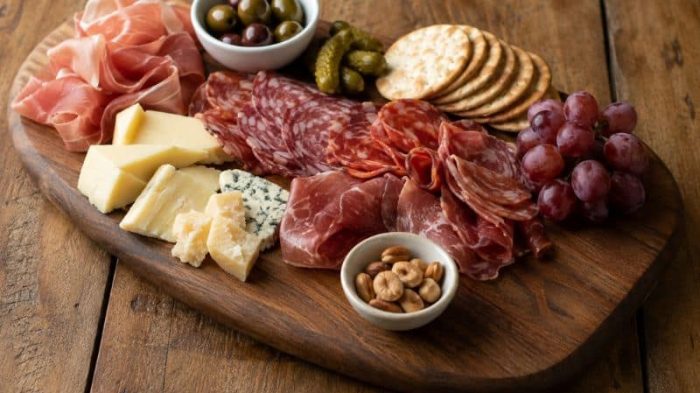
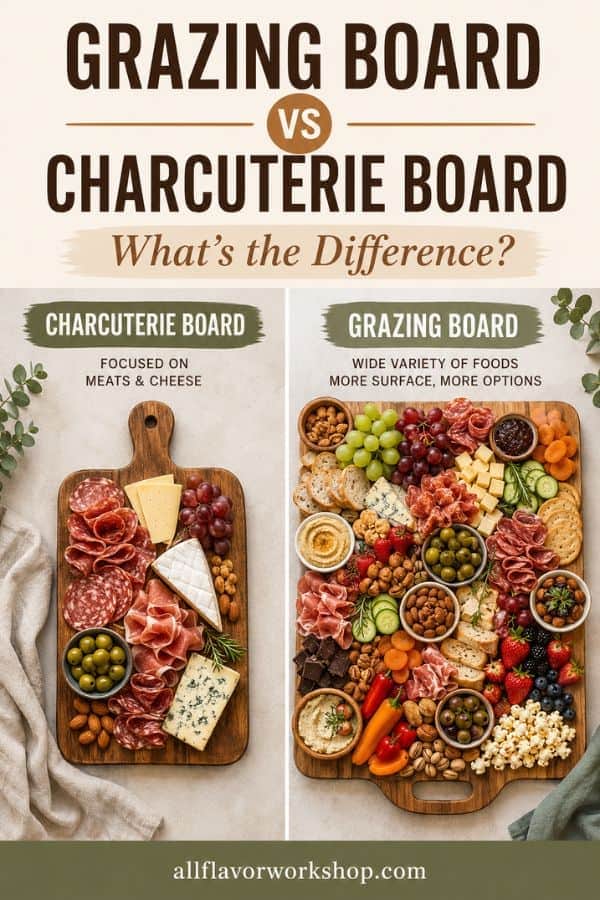
A traditional charcuterie board is centered around cured and prepared meats, usually with cheese and smaller accompaniments around them.
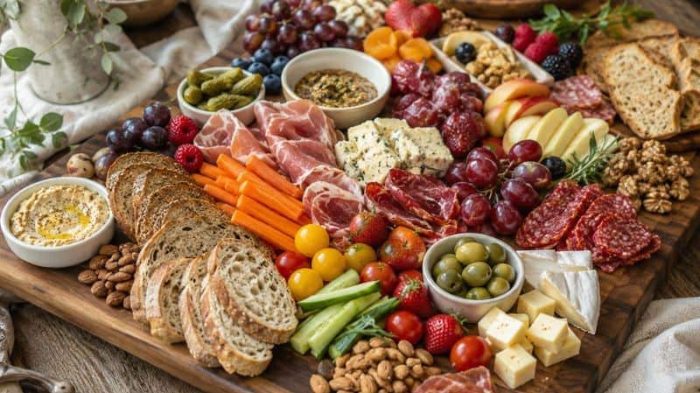
A grazing board is much broader. It is really a way of serving food rather than one specific type of food. It can include meat and cheese, but it can just as easily include sandwiches, vegetables, fruit, dips, bread, pastries, desserts, or a mix of almost everything.
From my woodworking perspective, there is another difference I find more interesting:
a grazing board often benefits from more space.
Once the food becomes more varied, larger bowls, bread, fruit, vegetables, and other items start taking up room quickly. That changes how I would think about the size, shape, weight, and layout of the wooden board underneath.
So although you can absolutely use the same board for both, I would usually design a dedicated grazing board a little differently from a smaller charcuterie board.
If you are also comparing the other common serving-board terms, see Charcuterie Board vs Cheese Board: What’s the Difference?.
Table of Contents
- Grazing Board vs Charcuterie Board: Quick Answer
- What Is a Charcuterie Board?
- What Is a Grazing Board?
- What Is the Main Difference?
- Is Every Charcuterie Board Also a Grazing Board?
- Does the Wooden Board Need to Be Different?
- Size Matters More for Grazing Boards
- What Wood Would I Use?
- What Features Make Sense on a Grazing Board?
- Grazing Board vs Grazing Table
- Can You Use the Same Board for Both?
- How I Would Build a Grazing Board
- Wrap-Up
- Frequently Asked Questions
Grazing Board vs Charcuterie Board: Quick Answer
The easiest way I think about the difference is:
- Charcuterie board → defined mainly by the food.
- Grazing board → defined mainly by the way the food is served.
A charcuterie board traditionally revolves around cured meats.
A grazing board can contain almost any collection of foods arranged so people can help themselves over time.
| Feature | Charcuterie Board | Grazing Board |
|---|---|---|
| Main focus | Cured meats, often with cheese | Mixed foods for casual sharing |
| Food variety | More focused | Usually broader |
| Typical foods | Cured meat, cheese, crackers, olives, fruit | Meat, cheese, vegetables, fruit, bread, dips, sandwiches, sweets, snacks |
| Typical size | Small to medium | Often medium to large |
| Serving style | Composed appetizer or snack board | Designed for people to pick from over time |
| Wooden board requirements | Food-safe serving surface | Same, but often benefits from more space |
The two can overlap completely.
A large board covered with prosciutto, salami, cheese, fruit, crackers, olives, and dips can realistically be described as both a charcuterie board and a grazing board.
What Is a Charcuterie Board?
Traditionally, charcuterie refers to prepared and preserved meats. That includes things such as:
- salami
- prosciutto
- cured ham
- sausages
- pâté
- terrines
A charcuterie board therefore begins with those meats and builds around them.
Cheese, crackers, bread, olives, pickles, fruit, nuts, mustard, honey, and other accompaniments can all be part of it.
Modern use has stretched the meaning quite a lot.
You will see dessert “charcuterie” boards, breakfast boards, candy boards, and plenty of other versions that do not actually contain charcuterie at all.
I do not think that matters much when you are serving food at home, but it does explain why these terms can become confusing.
If you want the more detailed comparison between charcuterie and cheese-focused boards, see Charcuterie Board vs Cheese Board.
What Is a Grazing Board?
A grazing board is less about one particular ingredient and more about how people eat from it. The idea is to put out a selection of foods that people can pick from casually over time.
That might include:
- cured meats
- cheeses
- bread
- crackers
- sandwiches or wraps
- vegetables
- dips
- fresh fruit
- dried fruit
- nuts
- olives
- pastries
- desserts
- sweets
There is much more freedom. A grazing board can be completely vegetarian and still be a grazing board. It could even be mostly fruit and desserts.
That would not really make sense under the traditional definition of charcuterie. This is why I think a grazing board is actually the broader term. It describes the serving format rather than one specific food tradition.
What Is the Main Difference?
For me, the distinction becomes much easier once you stop focusing on what the boards look like in photographs.
- A charcuterie board has a culinary identity.
- A grazing board has a serving identity.
| If the Board Is Mainly... | I Would Call It... |
|---|---|
| Cured meats with cheese and accompaniments | Charcuterie board |
| Cheese with fruit, crackers, and accompaniments | Cheese board |
| A large mixed selection for sharing | Grazing board |
| Meat, cheese, fruit, bread, dips, vegetables, sweets | Grazing board, possibly also charcuterie |
| Food spread over most of a full table | Grazing table |
There is no strict boundary where a charcuterie board suddenly becomes a grazing board. The categories overlap.
But once the food selection becomes broader and the setup is designed primarily around shared, casual eating, a grazing board is usually the more accurate description.
Is Every Charcuterie Board Also a Grazing Board?
In a broad sense, you could argue that it is. People are still picking foods from a shared board. But I would not use the terms as perfect synonyms.
A small wooden board with three cured meats, two cheeses, crackers, and olives is clearly a charcuterie board. I could call it a grazing board, but that does not tell you as much about what is actually on it.
The reverse is more important:
Not every grazing board is a charcuterie board.
A vegetarian grazing board with hummus, vegetables, bread, cheese, fruit, and nuts contains no charcuterie. Neither does a dessert grazing board.
That is the simplest way to see which term is broader.
Does the Wooden Board Need to Be Different?
Technically, no. A food-safe wooden serving board can work for:
- cheese
- charcuterie
- grazing
- appetizers
- snacks
- desserts
The wood does not know what food you put on top of it.
But from the builder’s side, I would start changing the design once I know the board is intended primarily for grazing.
The biggest consideration is space. A few slices of cured meat and cheese are easy to arrange.
Once you add:
- bowls of dips
- bread
- vegetables
- fruit
- sandwiches
- different cheeses
- meat
- crackers
…the board fills up surprisingly quickly.
So a grazing board is one case where I would generally lean toward a larger flat serving surface.
That is also why the dimensions matter differently from a normal kitchen cutting board.
In Cutting Board Sizes & Thicknesses, I talk about how board purpose should drive the dimensions. For serving, I usually care less about heavy-duty thickness and more about useful surface area and manageable weight.
Size Matters More for Grazing Boards
This is probably the main woodworking difference I would actually care about.
- With a normal charcuterie board, a medium-sized board can work very well.
- With a grazing board, I am more likely to go larger.
| Serving Style | Board Approach | What I Prioritize |
|---|---|---|
| Small charcuterie spread | Small to medium | Compact presentation |
| Charcuterie for several people | Medium | Meat, cheese, and accompaniments with some open space |
| Mixed grazing board | Medium to large | Lots of flat area for different foods and small bowls |
| Large gathering | Several boards or grazing table | Easy access and manageable weight |
One thing I would not automatically do is make one enormous, very thick board. A solid hardwood board becomes heavy quickly. And once you cover it with food and several ceramic bowls, it becomes even heavier.
For a bigger gathering, two or three medium boards can actually be much easier to carry, arrange, refill, and clean than one giant board.
That is the kind of practical detail I would decide in the workshop before worrying about how impressive one huge board looks.
What Wood Would I Use?
I would approach the wood choice almost exactly as I would for a cheese or charcuterie serving board.
My usual options would include:
- walnut
- maple
- beech
- cherry
For a grazing board, appearance matters, because much of the board remains visible between the food.
Walnut is particularly nice for this.
Its darker color gives a great background to lighter cheeses, bread, fruit, and vegetables, and the grain usually looks great with a simple food-safe oil or wax finish.
I also like face-grain construction for this kind of build.
A grazing board does not need the heavy-duty knife surface of a thick end-grain cutting board, so there is little reason for me to add all that extra weight and complexity.
If I want one board that can also handle occasional food preparation, I would still choose one of the woods I already trust for cutting boards.
See Best Wood for Cutting Boards for the species I normally work with.
What Features Make Sense on a Grazing Board?
Because the main job is serving rather than chopping, I would make slightly different choices.
1. Lots of Flat Surface
This is number one. I do not want unnecessary features breaking up the serving area.
Bowls, crackers, bread, fruit, and small foods are much easier to arrange on a simple flat board.
2. Handles
Handles become very useful as the board gets larger. I especially like finger grips routed underneath or into the sides because they make the board easier to lift without taking away surface area.
If you want to add them to a build, see How to Add Handles to a Cutting Board.
No Juice Groove
I would usually skip it. A juice groove takes away flat space around the edge — exactly where you could otherwise place crackers, fruit, or other smaller foods.
For grazing, I see very little benefit.
I cover that trade-off in Do You Need a Juice Groove? When It Helps and When It Doesn’t.
Moderate Thickness
I want enough thickness to keep the board stable and give it a quality feel, but I do not want unnecessary weight.
This is where serving boards differ significantly from my heavier everyday kitchen cutting boards.
Live Edge or Decorative Shape
A grazing board gives me more freedom to keep a live edge or make the shape more decorative. The board is part of the presentation.
That makes visual features more valuable than they would be on a board I primarily use for chopping vegetables every day.
Grazing Board vs Grazing Table
There is another term worth separating.
- A grazing board is still a portable serving surface.
- A grazing table moves the same idea to a much larger scale.
Instead of arranging everything on one board, the food is spread over:
- a large section of a table
- several boards
- trays
- bowls
- food-safe paper or another protected surface
Grazing tables are more suited to bigger parties, weddings, celebrations, or other situations where a single board would simply be too small.
From a woodworking perspective, I actually like the idea of using several matching wooden boards rather than trying to build one enormous slab.
You can place them beside each other to create a much larger spread, but each board remains practical to carry, clean, and store afterward.
That is something I would seriously consider if I were building a serving setup specifically for larger gatherings.
Can You Use the Same Board for Both?
Definitely. This is another comparison where you do not need separate physical boards unless you want them.
A good walnut serving board might be:
- a cheese board on Friday
- a charcuterie board on Saturday
- a grazing board at a birthday party
- a simple serving board the rest of the time
The food changes. The board does not have to.
If I were buying or building just one board, I would therefore focus on:
- useful size
- manageable weight
- suitable hardwood
- easy carrying
- plenty of flat surface
- food-safe finish
rather than whether someone has labeled it “grazing” or “charcuterie.”
How I Would Build a Grazing Board
If I were making one specifically for grazing, my starting point would probably be:
- face-grain walnut, beech, maple, or cherry
- larger than a typical small serving board
- thin-to-medium rather than heavy cutting-board thickness
- wide uninterrupted flat surface
- rounded or lightly chamfered edges
- finger grips underneath or on the sides
- no juice groove
- probably no rubber feet so either side can remain useful
- food-safe oil and wax finish
I would also think seriously about making two matching boards. That gives you more options.
-> For a normal evening, use one.
-> For a larger gathering, place both together.
They are easier to store, easier to clean, and easier to carry than one oversized board.
That is probably the biggest practical design choice I would make differently after thinking about the actual purpose.
My DIY Face Grain Cutting Board is already close to the type of construction I would use for a decorative serving or grazing board because the face grain becomes part of the design and the board does not need to be excessively thick.
📌 Save THIS PIN to your Board on Pinterest!
Wrap-Up
A grazing board and a charcuterie board can look almost identical, but they describe slightly different things.
A traditional charcuterie board is centered around cured and prepared meats, usually supported by cheese, crackers, fruit, olives, and similar accompaniments.
A grazing board is broader.
It can include charcuterie, but it can also include vegetables, dips, sandwiches, bread, desserts, fruit, pastries, or almost anything else people can casually pick from.
That is why I think of charcuterie as a type of food spread and grazing as a style of serving. From the woodworking side, the distinction is actually pretty simple. The same wooden board can do both jobs.
But if I were building one specifically for grazing, I would generally make it larger, relatively light, easy to carry, and as flat and uninterrupted as possible.
I would skip the juice groove, avoid unnecessary heavy construction, and focus on giving myself enough space to arrange different foods.
And for a bigger gathering, I would seriously consider making two matching boards rather than one giant one.
If you want to compare the other serving-board terms, continue with Charcuterie Board vs Cheese Board: What’s the Difference?.
And if you want to understand how these serving boards differ from an actual kitchen work surface, see Charcuterie Board vs Cutting Board: What’s the Difference?.
Frequently Asked Questions
What is the difference between a grazing board and a charcuterie board?
A charcuterie board is traditionally centered around cured and prepared meats, while a grazing board is a broader shared-food format that can include meat, cheese, fruit, vegetables, bread, dips, sandwiches, desserts, and many other foods.
Is a charcuterie board the same as a grazing board?
They overlap, but they are not exactly the same. A charcuterie board can be considered a type of grazing board, but a grazing board does not need to contain charcuterie at all.
Can a grazing board be vegetarian?
Yes. A grazing board can contain almost any combination of foods, including cheese, vegetables, fruit, bread, crackers, dips, nuts, and other vegetarian foods. It does not need cured meat.
Does a grazing board need to be larger than a charcuterie board?
Not necessarily, but grazing boards are often larger because they contain a wider variety of foods. If I were making one specifically for grazing, I would generally prioritize more flat serving area.
What is the difference between a grazing board and a grazing table?
A grazing board uses a portable board or platter, while a grazing table spreads the same style of shared food across a much larger table surface. For larger gatherings, several wooden boards can also be combined to create a grazing-table-style setup.
